Key Takeaways
- US President Donald Trump announced a landmark civilian nuclear deal with Saudi Arabia.
- The deal is subject to Riyadh's normalization of ties with Israel under the Abraham Accords.
- Two agreements were signed, laying the foundation for a strategic partnership between the US and Saudi Arabia.
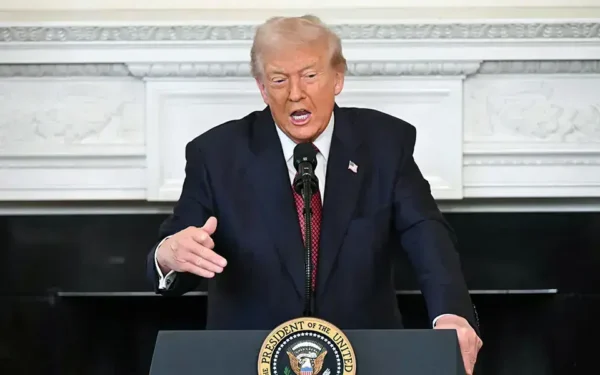
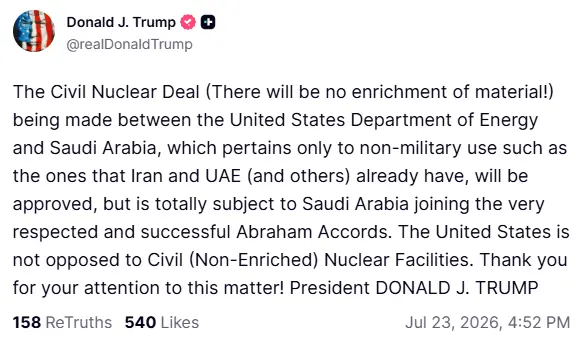
US President Donald Trump has announced that a landmark civilian nuclear deal with Saudi Arabia is contingent on the Gulf country joining the Abraham Accords and normalizing ties with Israel. In a post on Truth Social, Trump stated, 'The deal only pertains to the civilian use of nuclear facilities such as the ones that Iran and UAE (and others) already have.'
The Abraham Accords, brokered under President Trump in 2020, govern the normalization of diplomatic relations between Israel and countries that have historically been hostile to it. However, these agreements remain unpopular among many regional publics due to their lack of addressing the Israeli-Palestinian conflict.
Two key agreements were signed by US Energy Secretary Chris Wright and his Saudi counterpart Prince Abdulaziz bin Salman, according to a statement from the US Energy Department. These agreements lay the legal foundation for a decades-long, multi-billion-dollar partnership that advances several priority economic and strategic objectives, including nuclear non-proliferation.
The deal includes provisions potentially allowing US companies to build a uranium enrichment facility in Saudi Arabia, though this was not explicitly mentioned in the official statement from the Energy Department. When asked about it by AFP, no comment was provided.
The agreement will be submitted to Congress for review, but given its Republican-controlled status, it is unlikely to face significant opposition. US lawmakers and Israeli officials have previously expressed concerns over such a project due to fears that Saudi Arabia could eventually convert the facility into developing nuclear weapons.
Saudi Arabia, like Iran, has long been adamant about its right to pursue a civilian nuclear programme. The United States has sought in recent years to include any deal concerning a nuclear agreement in a wider strategic effort that would see Saudi Arabia normalizing ties with Israel and signing a US-Saudi defense pact. Pakistan and Saudi Arabia signed a mutual defense pact in September 2025.
Policymakers have long feared that if Iran produced a nuclear weapon, it could set off an arms race across the Gulf region. US Energy Secretary Wright dismissed concerns about proliferation during his statement.