Key Takeaways
- Prime Minister Shehbaz Sharif approved the draft Auto Policy 2026-31.
- The policy aims to increase auto sector exports to $6 billion by 2031.
- Tariffs on completely built-up units and CKD kits will be reduced by 15% by 2031.
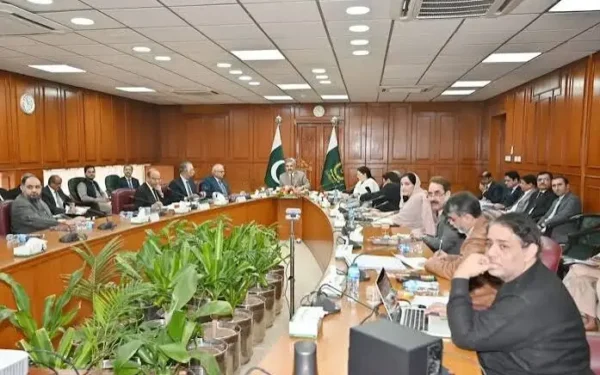
Prime Minister Shehbaz Sharif has approved the draft Auto Policy 2026-31, which aims to significantly boost the auto sector's exports and enhance local production and competitiveness, particularly in the electric vehicle (EV) market.
The policy, presented by Law Minister Azam Nazeer Tarar and Adviser on Industries and Production Haroon Akhtar, will be submitted to the federal cabinet for in-principle approval and subsequently to parliament for legislative endorsement.
Under the proposed policy, tariffs on completely built-up units (CBUs) and completely knocked-down (CKD) kits will be reduced by up to 15% by 2031, aiming to foster open competition in the sector.
The document also outlines a 1% sales tax on battery electric vehicles (BEVs) during the five-year period, with higher taxes on range-extended electric vehicles and plug-in hybrid vehicles.
To encourage EV adoption, the government has approved proposals to raise the financing limit from Rs3 million to Rs10 million and extend the repayment period from three to five years, making smaller vehicles more affordable for low-income consumers.
The policy sets a total export target of $6.01 billion over five years, with specific targets for each fiscal year, including $256.6 million for 2026-27 and $2.19 billion for 2030-31.
Manufacturers will receive incentives equivalent to 5% of export value for boosting exports, with an additional 10% incentive on exports exceeding the previous year’s level. Companies failing to meet their export targets will face penalties, and manufacturing certificates could be cancelled if targets remain unmet for two consecutive years.
The policy also aims to increase the use of locally manufactured auto parts, with penalties for companies that fail to meet local production targets.
The government expects to collect more than Rs232 billion through the Automotive Development Levy over five years, which will be used to finance export incentives and industrial development programmes.
The policy aims to bring the auto sector to open competition by significantly reducing tariffs on completely built-up units (CBUs) and completely knocked-down (CKD) kits up to 15pc by 2030-31.
Sources in the federal government, Not specified