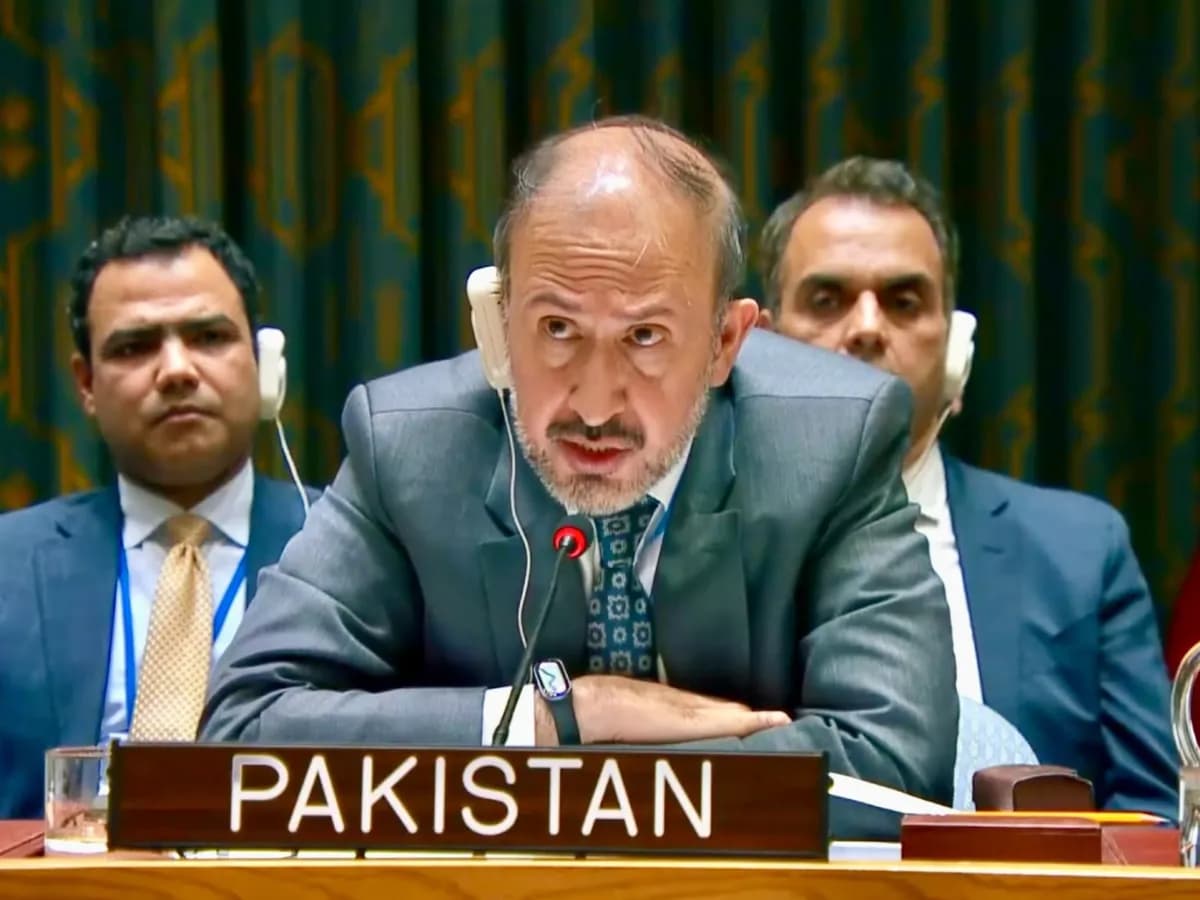
Pakistan has called for an immediate end to military provocations and attacks in the Gulf region, urging the protection of civilians and commercial shipping while seeking diplomatic solutions to heightened tensions. Addressing a United Nations Security Council meeting on Friday, Pakistan’s Permanent Representative to the UN, Ambassador Syed Haider Shah, stated that threats to maritime navigation were a matter of serious concern.
Ambassador Shah welcomed the Secretary-General of the Gulf Cooperation Council (GCC) to the meeting and thanked him for his briefing, saying his remarks highlighted the troubling implications of the escalation for the security of Gulf countries and stability across the wider region. He also thanked Assistant Secretary-General Khalid Khiari for his insights.
Shah emphasized that the region’s critical waterways sustain international commerce and carry essential supplies of energy and other commodities. He stated that Pakistan values its fraternal relations with Gulf countries, which he said are bound by faith, history and deep-rooted people-to-people ties, adding that their security and prosperity are of immense importance to Pakistan.
Emphasizing the need to uphold the sovereignty, territorial integrity and security of all regional states, Shah said Pakistan unequivocally condemned all attacks against GCC countries and stood in full solidarity with their governments and peoples. He also appreciated their support for dialogue, diplomatic engagement and the peaceful settlement of disputes.
The Pakistani envoy stated that attacks against civilian objects, including airports, energy installations and other civilian infrastructure, were unacceptable. “Pakistan condemns, in the strongest terms, the Houthi militia’s attacks and threats against the Kingdom of Saudi Arabia, including its civilian infrastructure and vessels engaged in lawful trade with the Kingdom,” Shah said. He added that these actions endangered regional peace, undermined navigational freedoms and disrupted international commerce.
Shah reaffirmed Pakistan’s solidarity with the Saudi government and people and its support for the kingdom’s sovereignty, territorial integrity, security and prosperity. Regarding maritime security, he noted that disruptions to commercial shipping and attacks on merchant vessels in Bab al-Mandab and the Strait of Hormuz highlighted the serious implications of maritime crises for the continent and countries.
“These actions endanger seafarers, undermine navigational freedoms and jeopardize regional stability. The attacks and threats must end,” Shah said. He warned that volatility at the maritime chokepoints had not only threatened peace and stability but had also driven up energy prices and heightened fears of global food insecurity, disproportionately affecting vulnerable economies.
Shah called for respect for navigational rights and freedoms, protection of commercial shipping and the unhindered delivery of humanitarian supplies to those in need. He noted the Strait of Hormuz was a critical maritime trade route for the transit of one-third of globally traded crude oil and a significant share of global fertiliser trade. He added that its geostrategic location also made it vital for regional security and stability.
Pakistan supported the restoration of normal passage, protection of vessels and crews, and safe and unimpeded commercial navigation. The ambassador said lasting peace and security required addressing the root causes and drivers of conflict and instability in the region. He called for efforts to establish a regional framework based on common security, peaceful coexistence, mutual prosperity and development.
Shah said Pakistan’s diplomatic efforts reflected its belief that lasting stability required respect for sovereignty, civilian protection and negotiated solutions. “All attacks must stop; communication channels should remain open; and regional initiatives and the Secretary-General’s good offices must receive sustained international support,” he said, adding that Pakistan remained committed to continuing its efforts towards that end.
The Security Council meeting also featured sharply conflicting accusations between the United States and Iran. Iranian Ambassador Gholamhossein Darzi accused Western members of the Council of ignoring the origins of the confrontation and attempting to reverse the roles of aggressor and victim. He identified what he described as unprovoked wars launched by the United States and Israel on June 13, 2025, and February 28, 2026, as the root causes of the current insecurity.
Recalling the attacks on Iran, Darzi said they violated international law and targeted the country’s supreme leader, government officials, nuclear scientists and civilian infrastructure. He put the Iranian death toll at 5,000, including 254 children, and described the attacks as war crimes and crimes against humanity. “The insecurity surrounding the Strait of Hormuz is a direct consequence of these acts,” Ambassador Darzi said.
Darzi argued that the presence of foreign military forces was itself a major source of instability and a threat to maritime safety. He rejected Security Council Resolution 2817 (2026), calling it politically motivated and accusing it of ignoring the origins of the crisis, denying Iran’s right to self-defence and failing to identify those responsible for the aggression.
The US representative, Ambassador Jennifer Locetta, presented a different picture, accusing Iran of aggression against its neighbours and threats to international shipping. “The regime attacks its neighbors, fires on commercial ships, arms terrorist proxies, and defies this Council at every turn,” she said. She stated that Iranian missiles, drones and what she described as unlawful mines in the Strait of Hormuz, along with attacks in the Bab al-Mandab Strait, threatened global energy and food security.
Ambassador Locetta cited Security Council Resolution 2817, which demanded that Iran stop attacks on shipping and neighbouring states and had attracted 136 co-sponsors, saying Tehran was defying the international community. “Iran ignores this Council. It ignores the overwhelming opinion of the international community,” she said. She also accused the Houthis of attacking Saudi airports and energy installations with Iranian backing and imposing an illegal, self-declared embargo on maritime traffic through the Bab al-Mandab Strait.
The GCC presented its own account of the attacks against its member states. Secretary-General Jasem Mohamed Albudaiwi said Gulf countries had faced more than 7,000 Iranian missiles and drones since February 28, targeting airports, ports, oil and gas facilities, power stations, water desalination plants and residential neighbourhoods. He said the attacks had caused deaths and injuries, extensive damage to property and infrastructure, and serious environmental repercussions in the Arabian Gulf.
Earlier, speaking on behalf of the GCC, Bahrain’s Ambassador Jamal Fares Alrowaiei welcomed mediation efforts by Oman, Qatar and Pakistan and reaffirmed the bloc’s commitment to diplomacy and de-escalation. “The security of the GCC States is indivisible,” he said, insisting that Gulf countries must participate in any negotiations concerning regional security.