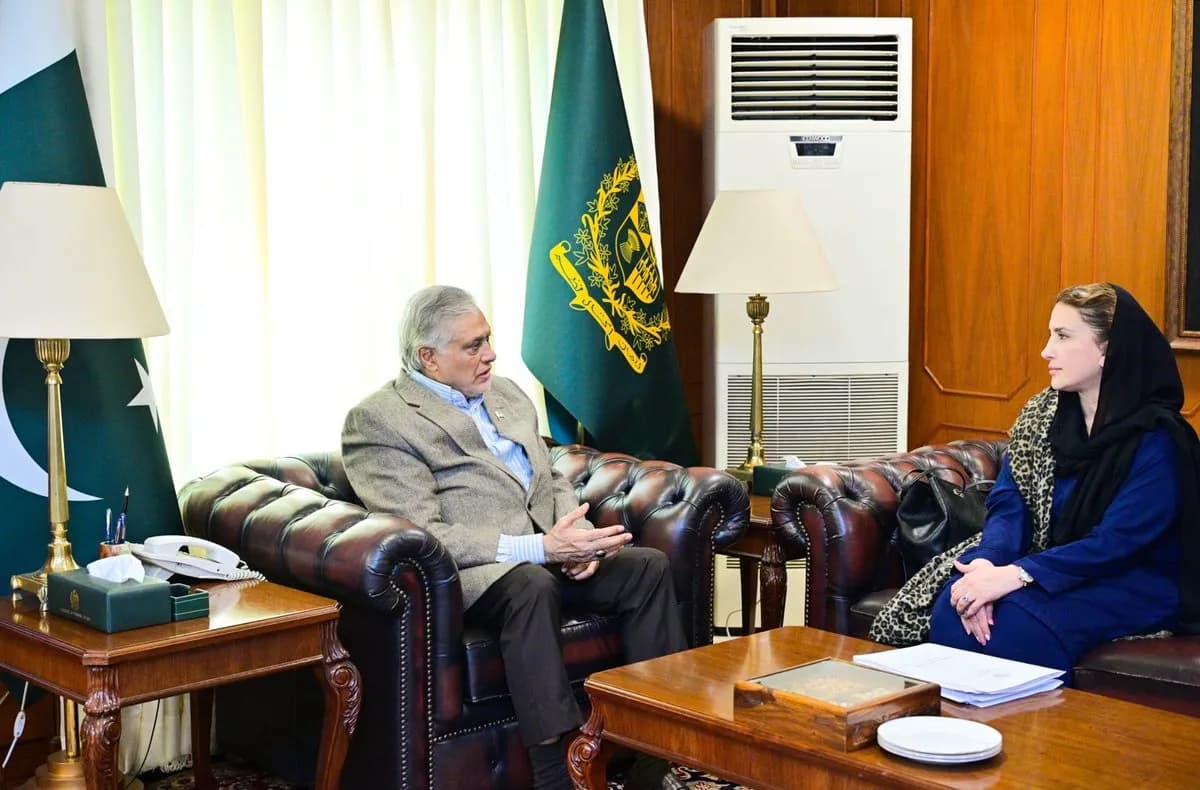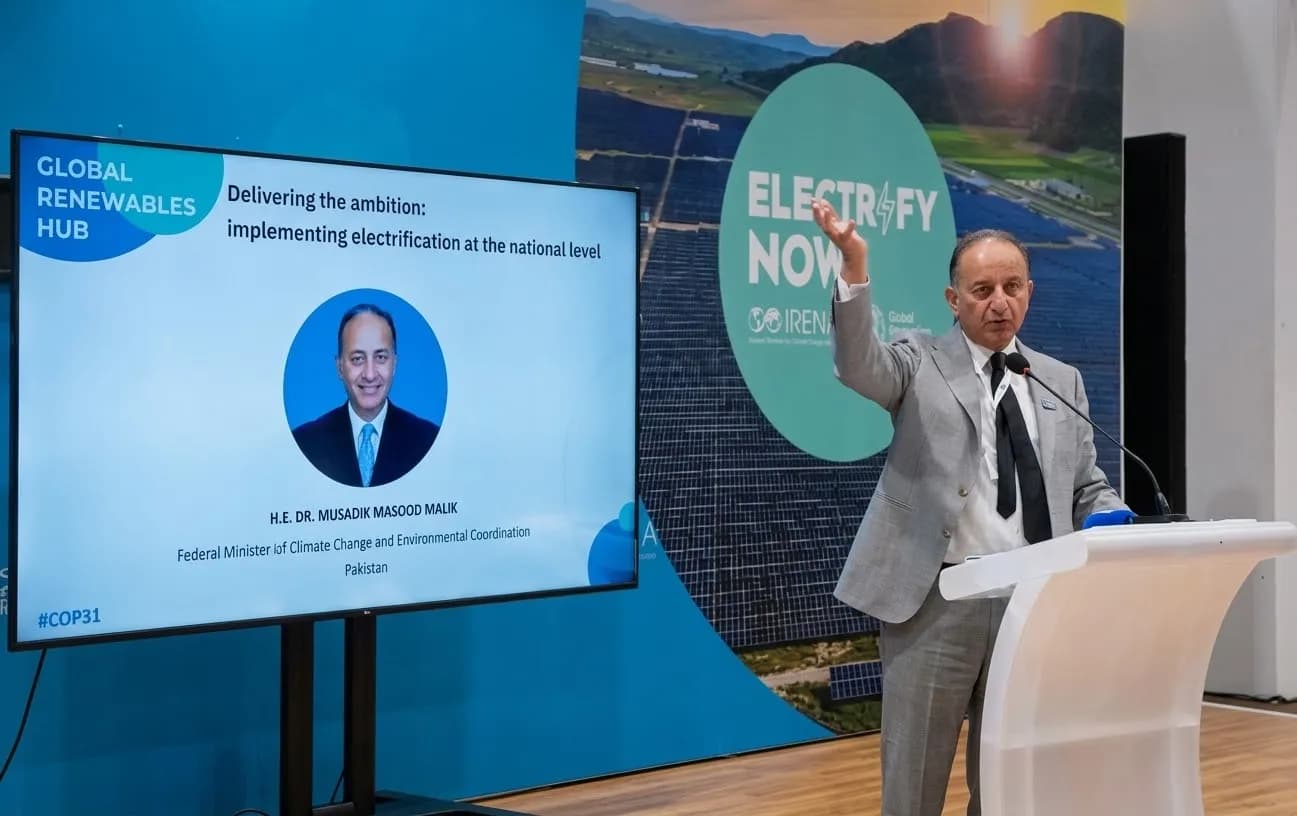
Federal Minister for Climate Change Dr Musadik Malik has called for a shift in international climate financing to provide direct support for households adopting renewable energy. Speaking at a ministerial panel titled “From Pledge to Plans: Electrifying the Transition” at the Global Renewables Hub during the 31st United Nations Climate Change Conference (COP31) in Antalya, Türkiye, on November 14, Malik stated that Pakistan’s rooftop solar expansion shows how ordinary people are driving the energy transition due to economic pressures.
Malik noted that Pakistan’s solar transition is increasingly driven by households making independent investments in rooftop installations, often without government or international financial assistance. To illustrate this, he shared the story of a villager named Karamat Ali, who sold 12 buffaloes and cows to buy rooftop solar panels. Malik described livestock as a poor family’s financial security for milk, income, and savings for emergencies or children’s marriages, but said the villager chose to invest in solar because it was a more reliable and economically viable option than grid electricity and unpredictable fuel prices.
The minister said this example reflects a broader trend of hundreds of thousands of households choosing to secure affordable electricity. He described the development as a people-driven energy revolution challenging the conventional centralised electricity distribution model. Malik claimed that Pakistan had saved around $12 billion in LNG and gas imports through the growing adoption of rooftop solar.
Comparing the traditional grid to a canal system, Malik said consumers upstream historically enjoyed greater access while poorer communities downstream received little benefit. He stated the rooftop solar model offers an alternative where households generate electricity locally and store surplus power. However, he stressed that panels alone are insufficient and called for investment in battery storage and improved grid connectivity. “Wire them,” Malik urged international partners, arguing that while households have invested in generation, they lack the resources and capacity for storage and connectivity infrastructure.
Malik called for climate financing to reach households directly instead of being absorbed by bureaucratic processes. He urged partners to identify vulnerable communities and support people investing in renewable energy, stating that financing should respond to household needs rather than being driven exclusively by supply-side considerations. He also called for countries to prioritise tangible action over lengthy international declarations and for consistency in energy and climate policies.
Recalling the 2022 floods in Pakistan, Malik described how families, particularly mothers and children, were forced to take refuge on rooftops. He said this illustrated the human cost of climate change in vulnerable countries, where communities measure disasters through the loss of homes and livelihoods. Regarding international support, he questioned the gap between commitments and actual assistance, citing an estimated $40 billion in requirements, $800 million in commitments, and $400 million collected for the Loss and Damage Fund, claiming that no money had reached affected communities to date.