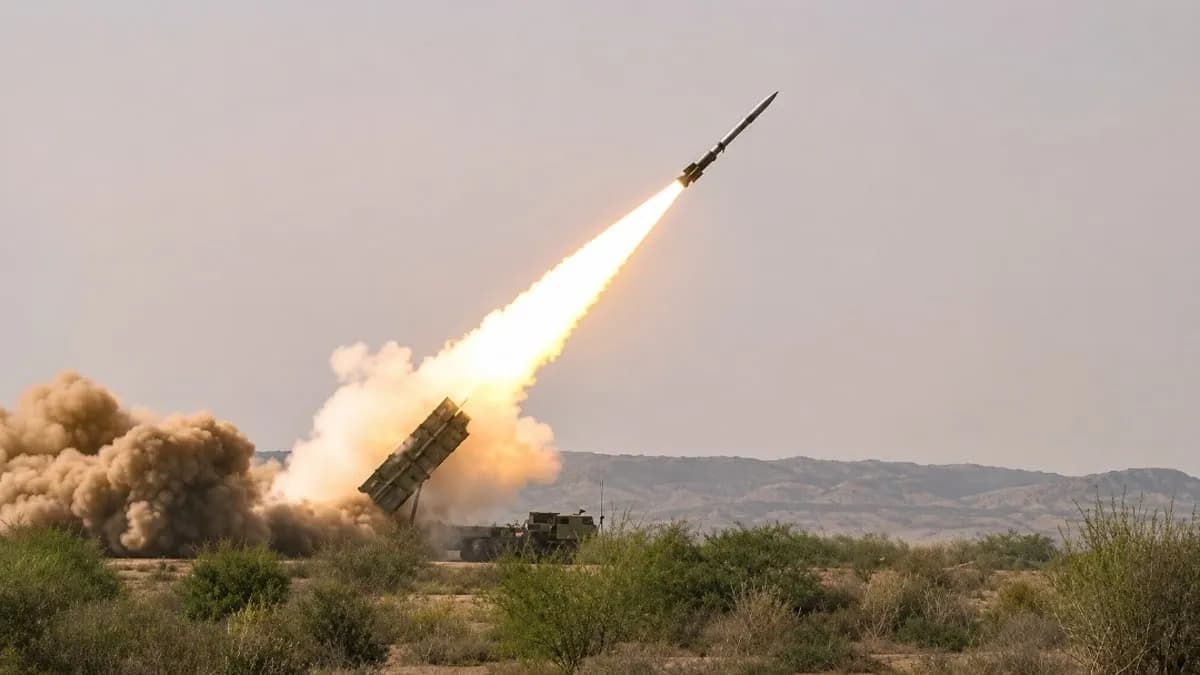
The Pakistan Army successfully launched the Fatah-3 supersonic cruise missile on Wednesday, according to a statement from the Inter-Services Public Relations (ISPR). The military's media wing described the launch as another significant milestone in strengthening the country’s national defence capabilities.
The ISPR stated that "The weapon system is equipped with advanced navigation and propulsion systems and is capable of engaging targets at long range with high precision and lethality at supersonic speed." The missile is expected to "significantly enhance the operational flexibility and strike range of the Pakistan Army’s Rocket Force Command, further strengthening the country’s overall conventional deterrence and defence posture."
The launch was witnessed by the Commander of the Army Rocket Force Command, along with senior military officers, scientists, and engineers.
President Asif Ali Zardari, Prime Minister Shehbaz Sharif, Chief of Army Staff and Chief of Defence Forces Field Marshal Syed Asim Munir, and the services chiefs commended the successful launch. They expressed appreciation for the dedication and commitment of those who contributed to the development of Pakistan's national defence capabilities.
Interior Minister Mohsin Naqvi also congratulated the nation, stating that the launch represented a "significant advancement in the defence sector." He added, "The successful test of the Fatah-3 supersonic cruise missile marks a major milestone in the country’s defence capabilities."
This test follows other recent developments in the country's aerospace and defence sectors. Earlier this month, the Pakistan Air Force performed a successful flight test of the Fa’az, the country’s first indigenously developed air-to-air missile, which the ISPR called "another significant milestone in the advancement of national aerospace and defence capabilities."
In October, Pakistan successfully tested two other missiles: the Fatah-IV ground-launched cruise missile (extended version) on Oct 6, and the Fatah-2 extended-range hypersonic ballistic missile on Oct 13.