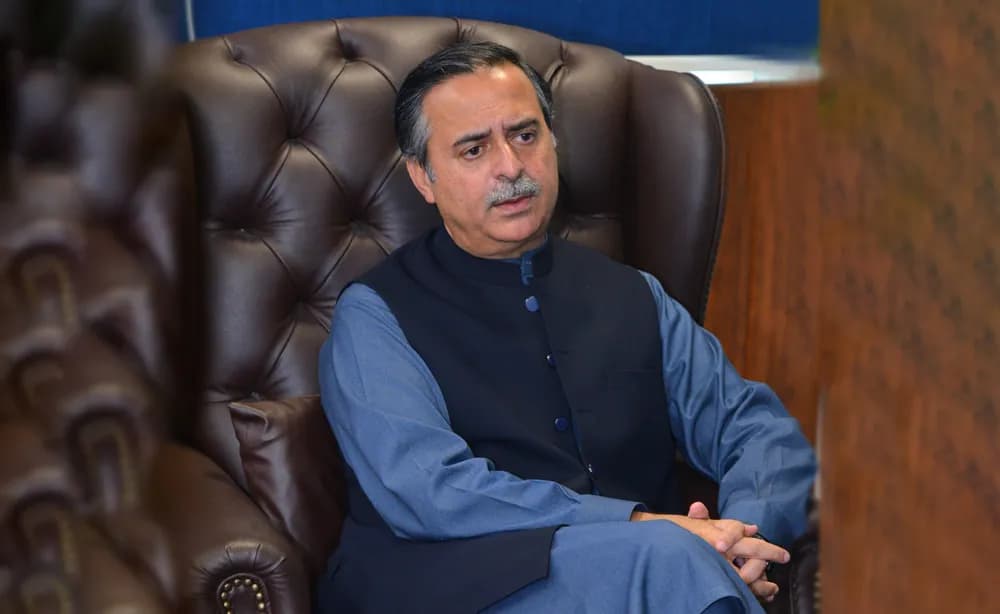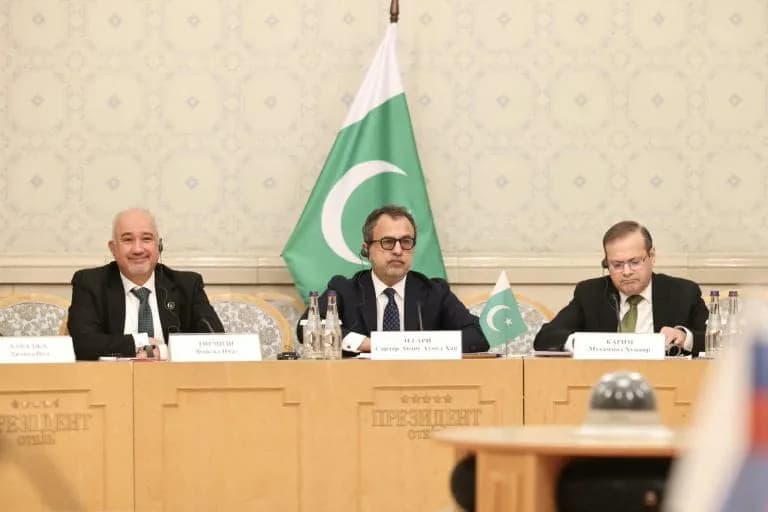
Federal Minister for Power Sardar Awais Ahmad Khan Leghari announced on Wednesday that Pakistan and Russia have set a target to increase their bilateral trade volume to $5 billion by 2030. Speaking in Moscow during the 11th session of the Pakistan-Russia Intergovernmental Commission (IGC), Leghari described the goal as an important step toward strengthening economic cooperation between the two nations.
Leghari stated that the two countries possess significant opportunities to expand trade, investment, and cooperation in key sectors. He noted that Pakistan views Russia as a valued friend and partner in development, stability, and long-term economic progress, adding that both sides met with a “clear purpose” to advance ties.
The minister acknowledged the work of technical teams from both nations, stating, “I acknowledge the efforts of the technical teams on both sides whose consultations have brought us to this plenary with a comprehensive protocol.” He noted that the agenda reflected a shared desire to make the mechanism more result-oriented and stressed that decisions must not remain on paper. He insisted that each initiative must be followed through by the relevant ministry or organization with “clear responsibility, regular communication, and a focus on implementation.”
Leghari explained that while the estimated bilateral trade potential is around $2 billion, this could be realized through an alternative banking channel. He suggested that stronger institutional engagement and private-sector participation would help reach the proposed higher target of $5 billion.
A major milestone of the session was the signing of the Programme of Economic Cooperation between Pakistan and Russia for 2026-2030. Leghari said this programme provides a structured framework for enhancing economic engagement over the next five years and reflects a shared commitment to deepen trade, investment, and direct cooperation between businesses.
Regarding trade agreements, Leghari stated that a joint feasibility study on a possible Pakistan-Eurasian Economic Union Free Trade Agreement has been finalized and recommended moving toward negotiations. He expressed hope that further consultations would help advance the initiative and facilitate market access.
The minister highlighted several specific areas for cooperation:
In energy, Pakistan seeks deeper engagement with Russian companies in oil and gas exploration and production, including onshore and offshore areas. In the power sector, he identified high-voltage transmission, grid operations, system stability, and energy efficiency as areas to support the modernization of Pakistan’s energy system.
For industry, Leghari highlighted opportunities for Russian technical assistance in the revival and modernization of Pakistan Steel Mills. On regional connectivity, he emphasized the early operationalization of a pilot cargo train between Pakistan and Russia under the International North-South Transport Corridor (INSTC) to reduce transit time and improve trade predictability.
Leghari also identified healthcare cooperation—including local insulin production, pharmaceuticals, and regulatory engagement—as a way to promote technology transfer. Agriculture was noted as another promising area for expanding trade in products and cooperating on modern machinery, precision agriculture, seeds, livestock, fisheries, and aquaculture.
Finally, the minister called for stronger institutional links in higher education, science and technology, digital development, culture, sports, youth affairs, and disaster management through exchanges among researchers and professionals. He thanked the Russian government for its hospitality and expressed confidence that regular communication and the resolution of outstanding issues would lead to tangible results.