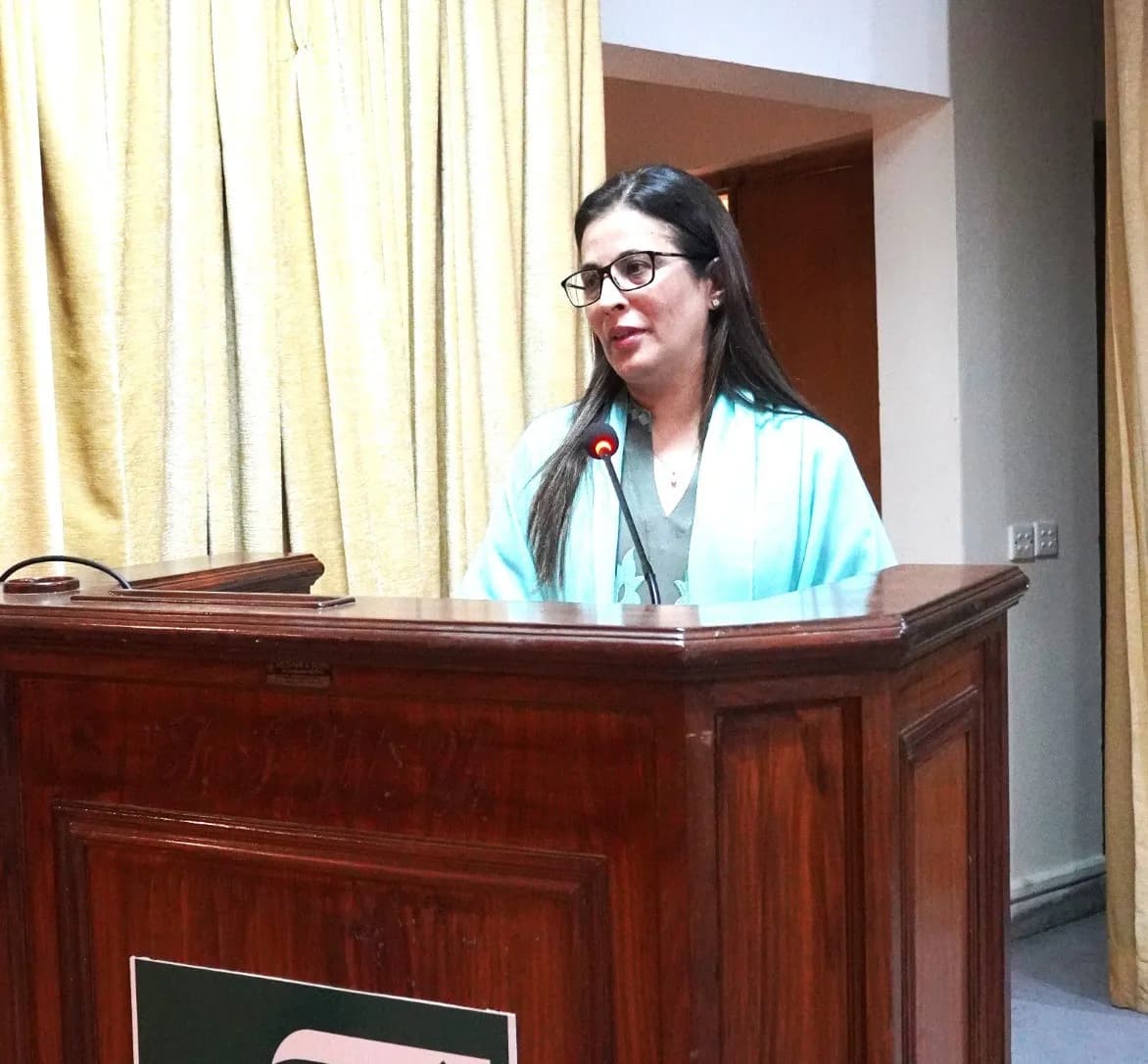
Supreme Court of Pakistan (SCP) Judge Justice Ayesha Malik stated on Thursday that Pakistan has strong statutory laws to protect women, but converting these legal rights into actual protection requires legal literacy, effective enforcement, and a gender perspective that challenges entrenched patriarchal mindsets.
Speaking as the keynote speaker at a seminar titled “Human Rights and Legal Awareness” at Fatima Jinnah Women University (FJWU) on November 26, Malik noted that women make up 49 percent of the country's population but lack substantive equality. She provided specific figures, noting that only 14 percent of women hold bank accounts, 2 percent own homes or debit cards, 33 percent have mobile phones, and 24 percent participate in the workforce.
Malik identified three primary barriers to gender justice: entrenched social mindsets, male-centric narratives, and weak enforcement. She explained that landmark judicial rulings, such as the Nadia Naz case review and the abolition of the unscientific “two-finger” virginity test, have expanded workplace harassment jurisprudence. This expansion now covers gender-based discrimination, power dynamics, psychological bullying, and cyber harassment, rather than just physical acts.
The judge emphasized that university students and employees are legally protected by provincial ombudspersons and mandatory institutional inquiry committees, which must include at least one female member. She also noted that parallel remedies exist under criminal law and the Prevention of Electronic Crimes Act (PECA). Regarding evidence, Malik underlined that a complainant’s credible testimony is sufficient without eyewitnesses, and that reporting delays do not invalidate a complaint. She further stated that strict confidentiality is legally guaranteed to protect survivor dignity and prevent retaliation.
Malik urged young women to reject victim-blaming stereotypes and to build supportive communities. She stressed the importance of creating awareness among the large female population through writings, seminars, and university radio services. “Legal reform only succeeds when educated citizens actively enforce the law’s promise in everyday life rather than leaving protections confined to paper”, Malik said.
In her closing remarks, Fatima Jinnah Women University Vice Chancellor Prof. Dr. Bushra Mirza thanked Malik for sharing judicial insights and noted that Malik was the first woman judge of the Supreme Court. Mirza stated that having women on decision-making benches ensures a vital gender perspective in legal interpretation. Mirza also expressed the university's interest in collaborating with Malik’s office through its Women Research and Resource Center to conduct data-driven research on gender challenges.