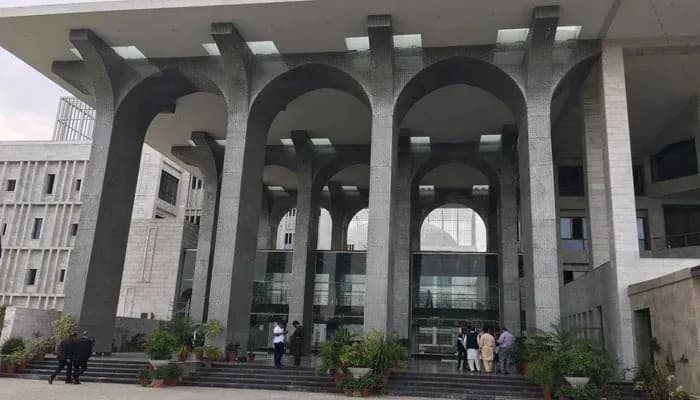
The Islamabad High Court (IHC) reserved its verdict on Thursday regarding the maintainability of an intra-court appeal. The appeal challenges a single bench decision involving actions taken by the Capital Development Authority (CDA) against Bari Imam House.
A division bench consisting of Justice Azam Khan and Justice Muhammad Asif heard the appeal, which was filed by Muhammad Akmal and represented by counsel Ahsan Bhoon. During the proceedings, the court instructed the counsel to read the concluding paragraph of the single bench judgment.
Counsel Ahsan Bhoon argued that the site had not yet been demarcated and requested a joint demarcation before any further steps are taken. Bhoon stated that the revenue record showed the shrine of Golra Sharif, along with other land, had been granted an exemption. He noted that while thousands of visitors come to the shrine of Hazrat Bari Imam, the langar facility has been discontinued.
Bhoon maintained that the revenue record shows no road exists at the site and noted that a committee has been formed to examine the matter. He clarified that he is the hereditary custodian of the shrine, not the personal owner. He stated that visitors stay at the site and no commercial activity has ever occurred there.
Bhoon further claimed that more than 600 acres of land in the Golra revenue estate were exempted. He informed the court of a dispute regarding the site's size, stating that while the CDA claims it measures 60 kanals, he maintains it is 35 kanals. He requested the court to appoint a local commission to inspect the site and establish the facts.
Justice Azam Khan questioned whether the matter involved the shrine or a residential property and inquired about the land's status in the revenue record.
Counsel for the CDA, Kashif Ali Malik, argued that the disputed structures are encroachments according to the authority's records. Malik stated that while religious figures are held in great respect, he warned against a trend of occupying state land in the name of revered personalities. He questioned the petitioner’s standing to file the case, arguing that a person who is not an aggrieved party cannot maintain such a petition.
Malik further argued that accepting the plea could encourage others to claim ownership of public land by displaying photographs of religious personalities. He cited similar instances in Saidpur Village and other areas, asserting that the presence of photographs and utility meters does not change the ownership status of state land.
Ahsan Bhoon objected to the allegation of occupying land in the name of religion, describing the accusation as unfortunate. He reiterated that the site is used by visitors and that a committee has been constituted to look into the issue. The appellant’s counsel requested the court to suspend the single bench decision.
After hearing the arguments, the division bench reserved its verdict on the maintainability of the appeal.