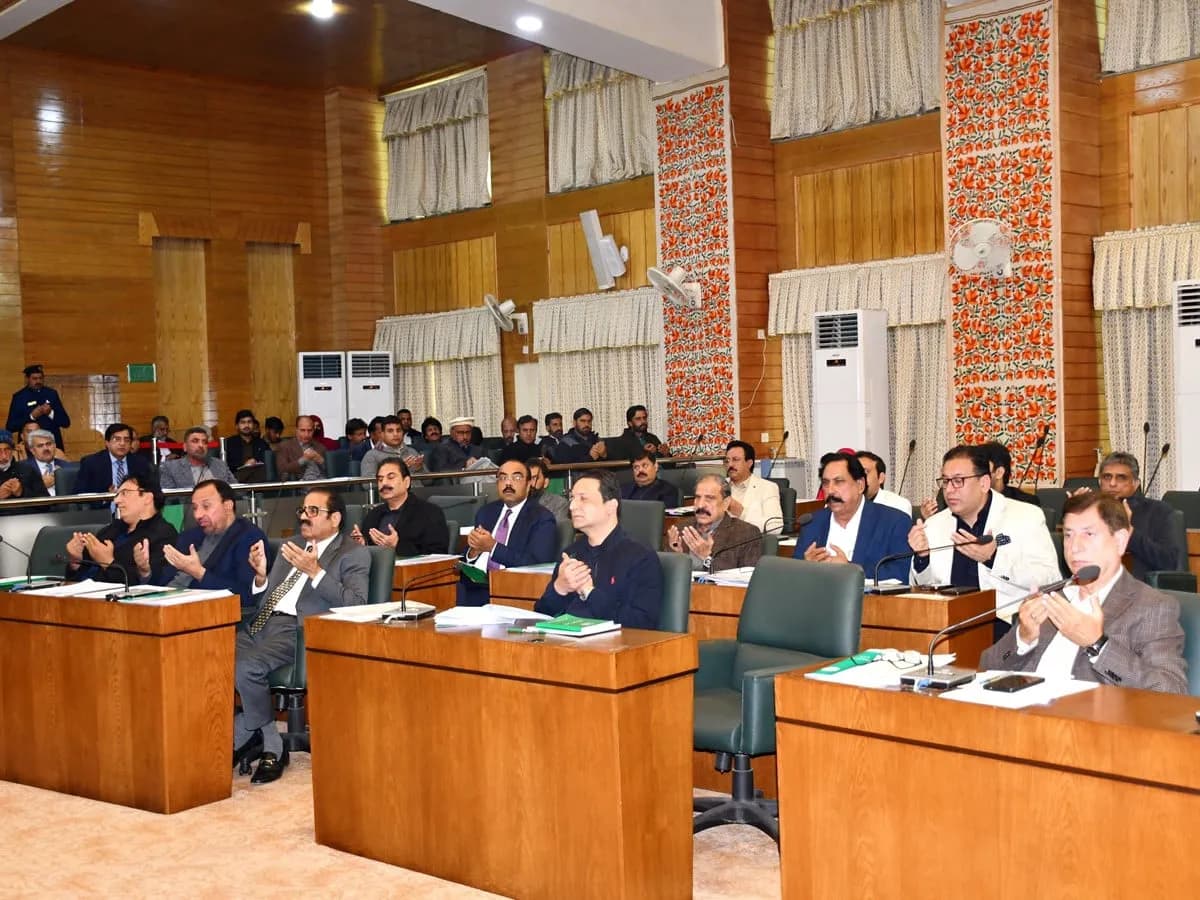
The Azad Jammu and Kashmir Legislative Assembly (AJKLA) on Wednesday expressed a conditional willingness to resume talks with the banned Joint Awami Action Committee (JAAC). The House stated it would be prepared for meaningful political dialogue under the Interim Constitution of 1974 and relevant laws, provided the JAAC meets specific demands.
These conditions include the disbandment of armed groups, the handover of individuals allegedly involved in serious offences to law enforcement, and an unequivocal commitment to pursue demands through constitutional and democratic means. The resolution was unanimously adopted during a session chaired by AJK Legislative Assembly Speaker Chaudhry Tariq Farooq.
The resolution, which was read out by Forests Minister Waqar Ahmed Noor, held the JAAC leadership primarily responsible for the breakdown of previous negotiations. It alleged that the committee advanced unconstitutional demands despite concessions offered by the government. The House claimed that the JAAC interpreted these concessions as weakness and rejected alternative avenues for resolving disputes, such as high-level negotiations, participation in a multi-party conference, a referendum on constitutional matters, or seeking the AJK Supreme Court’s opinion through a reference.
The assembly condemned the presence of armed groups, the closure of highways, attacks on government institutions, and violence against law enforcement personnel. It specifically accused elements affiliated with the JAAC of obstructing law enforcement agencies, attacking hospitals, threatening officials, and establishing armed checkpoints. The resolution further alleged that armed groups obstructed the supply of essential commodities and carried out lethal attacks on law enforcement personnel.
The House also demanded an end to all sit-ins and unlawful protests, the reopening of blocked highways, and a public apology from the JAAC leadership for what it described as an anti-state narrative directed against state institutions, law enforcement personnel, Pakistan, and the freedom struggle of Indian Illegally Occupied Jammu and Kashmir IIoJK.
According to figures presented in the assembly, 34 law enforcement personnel were martyred and 248 injured during the unrest that began in June. The lawmakers paid tribute to the martyred personnel and expressed solidarity with their bereaved families.
While recognizing peaceful protest and political dissent as fundamental civic rights, the resolution stressed that these rights could not be used to justify violence, damage to public property, or restrictions on citizens’ movement. The government was authorized to take necessary legal action within constitutional limits to maintain law and order.
The resolution echoed allegations that the JAAC leadership used social media to promote a narrative contrary to facts and exaggerate casualties, spreading anxiety among Pakistanis and Kashmiris living abroad. It also noted that the violence has forced women, children, and elderly people to leave affected areas for safety.
The session also offered Fateha for former Azad Jammu and Kashmir president Raja Zulqarnain Khan. The resolution was jointly moved by Deputy Speaker Mohammad Ahmed Raza Qadri, Forests Minister Waqar Ahmed Noor, Health Minister Dr Mustafa Bashir Abbasi, Education Minister Umair Naeem, Energy and Water Resources Minister Saqib Majeed Raja, and MLA Chaudhry Mohammad Ismail.
Additionally, the House approved three resolutions: Pir Mazhar Saeed called for displaying Quranic verses affirming the finality of prophethood in the Assembly hall; Sehrish Qamar welcomed the recent visit of the PML-N leadership to Muzaffarabad; and Opposition Leader Chaudhry Muhammad Yasin paid tribute to former president Raja Zulqarnain Khan.
The Human Rights Commission of Pakistan (HRCP) expressed concern over “reports of a fresh spate of violence in Rawalakot in AJK, with allegations of casualties among both protesters and law enforcement personnel”. The HRCP stated, “The priority must be to prevent any loss of life and resolve the situation through political dialogue rather than by force,” and called for the media to be “given unhindered access to report from the region independently”.