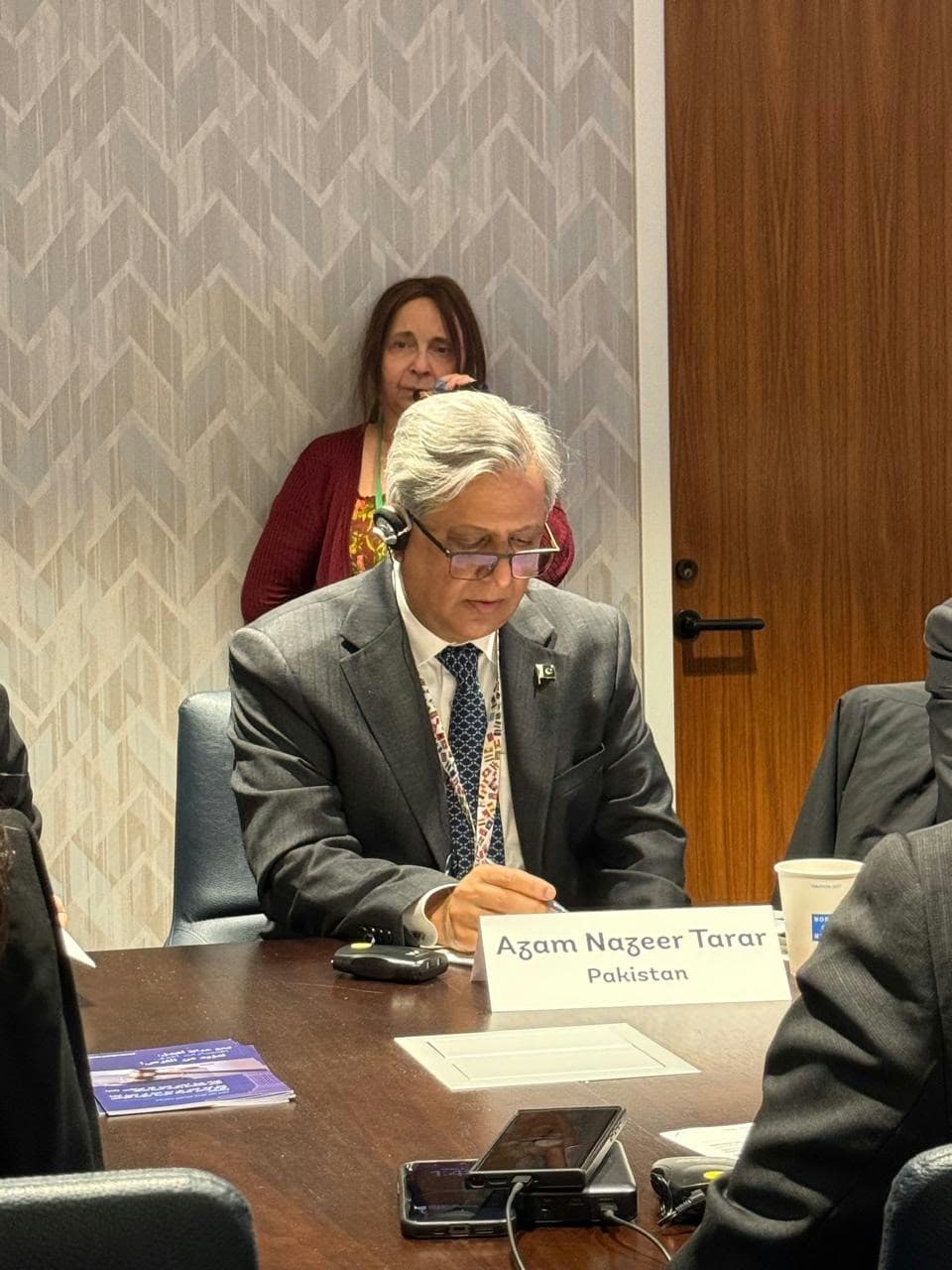
Federal Minister for Law and Justice Senator Azam Nazeer Tarar represented Pakistan at the Law, Justice and Development (LJD) Forum 2026 at the World Bank Group headquarters in Washington, D.C. During the event, he identified the nation's ongoing legal and judicial reforms as primary drivers for institutional strengthening, investor confidence, and economic growth.
The forum gathered more than 40 ministers and senior legal leaders from around the world to discuss mobilizing private investment and promoting economic growth through justice reforms. On the first day, Senator Tarar spoke at the Ministerial Roundtable session titled “What Legal Reforms Are Required to Mobilize Private Capital?” He stated that private investment relies on confidence, which can be bolstered by the prompt, fair, and predictable enforcement of contracts.
Senator Tarar also took part in Leadership Lounge discussions with other ministers to exchange views on development financing, judicial reforms, and commercial disputes. While presenting Pakistan’s reform agenda, he stated that justice reform is an integral part of economic reform. He noted several initiatives to improve the business environment, including the Asaan Karobar law, which creates a national one-window business portal and a single registry for licenses and permits. He also mentioned the establishment of a one-stop shop for investors and the Foreign Investment Promotion and Protection Act 2022 (FIPPA) to protect major foreign investments.
The minister highlighted proposed amendments to the Companies Act by the Board of Investment and the Securities and Exchange Commission of Pakistan (SECP). These proposed changes aim to facilitate online corporate filings and replace certain criminal penalties with financial fines. To improve the resolution of commercial disputes, he outlined efforts regarding specialized commercial courts, court-connected mediation, and a new Arbitration Act based on the UNCITRAL Model Law to replace the 1940 legislation. Additionally, he noted the establishment of the International Mediation and Arbitration Centre (IMAC) in Islamabad and confirmed that Pakistan has signed the Singapore Convention on Mediation, with legislation for ratification currently being prepared.
On the second day, Senator Tarar joined the MENAAP (Middle East, North Africa, Afghanistan and Pakistan) Regional Ministerial Dialogue with ministers from Egypt, Lebanon, Saudi Arabia, and Sharjah, United Arab Emirates. He presented Pakistan’s national priorities and called for regional cooperation to modernize justice systems. He proposed regional exchanges of experience regarding business reforms, arbitration centers, and commercial courts, as well as faster cross-border enforcement of mediated settlements and arbitral awards. He offered to host regional counterparts at IMAC in Islamabad.
Senator Tarar invited the World Bank to support Pakistan’s roadmap for improving international governance indicators and its reforms concerning mediation, arbitration, and commercial courts. He proposed creating a regular regional platform for modernizing justice systems and stated that Pakistan is ready to share experiences, learn from partners, and work with the World Bank on practical initiatives to improve the investment climate.