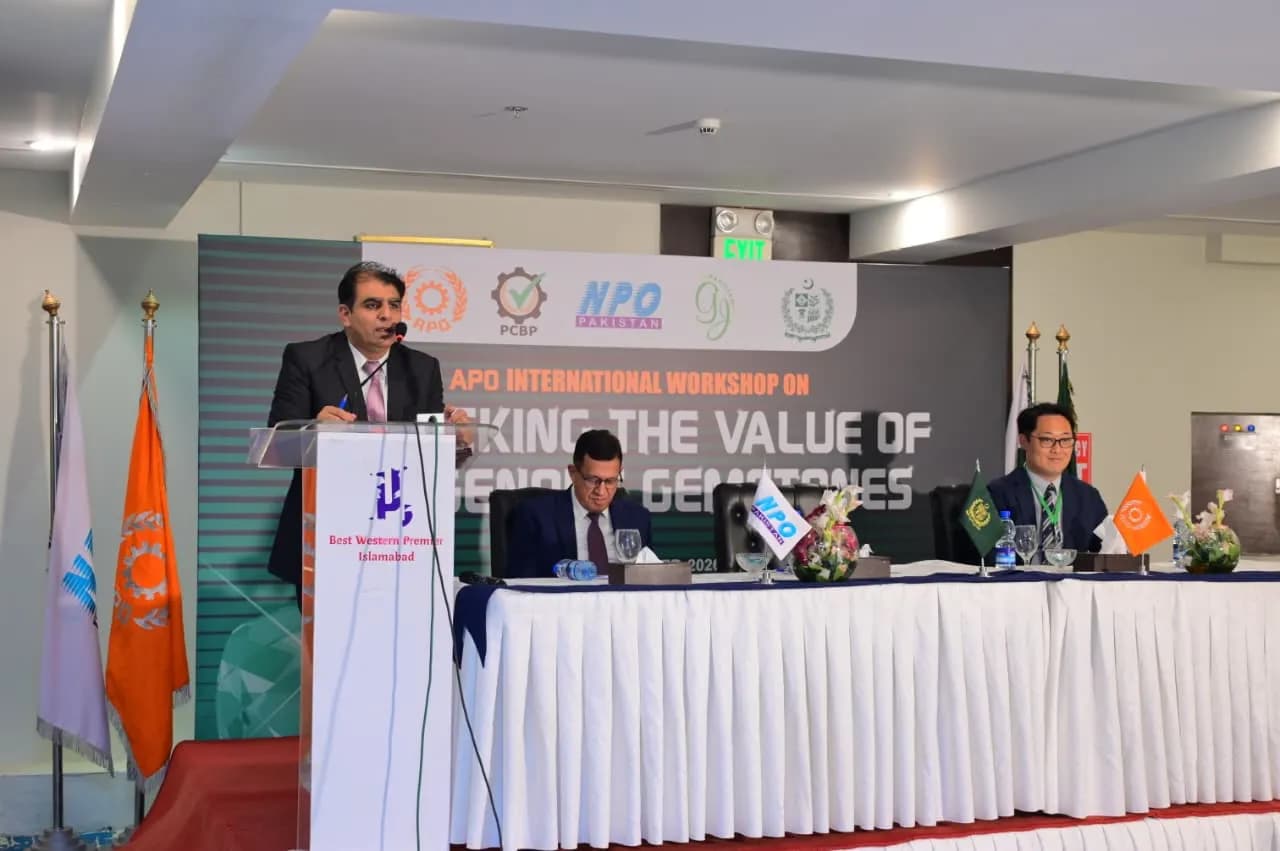
Pakistan is aiming to reach $1 billion in annual gemstone exports by moving away from the export of raw stones toward local processing, value addition, and internationally recognized certification. This objective was highlighted at the conclusion of a four-day international workshop titled “Unlocking the Value of Indigenous Gemstones” in Islamabad.
The government intends to unlock the country's mineral potential by implementing industry reforms and technical cooperation. During the workshop, officials and international experts emphasized that the industry must modernize mining practices, upgrade skills, and strengthen certification systems to become globally competitive.
Pakistan Gems and Jewellery Development Company (PGJDC) Chief Executive Officer Toufeeque Ahmed Arain stated that more than 70 percent of the country’s gemstones have historically been exported in raw form, which has deprived Pakistan of the economic returns gained from cutting, polishing, and processing. Arain noted that the government's priority is to formalize the sector and improve product quality to meet international standards.
“The technology required for this sector is not very expensive, but quality skills are essential to bring Pakistan’s industry at par with international standards,” Arain said, while stressing the need for sustained cooperation with international partners.
Arain announced that the PGJDC is expected to sign a memorandum of understanding with Gem and Jewelry Institute of Thailand (GIT) in February. He also noted that discussions with Sri Lanka’s National Gem and Jewellery Authority have advanced, with an agreement expected in January. Additionally, cooperation with Cambodian partners is under consideration. These proposed partnerships are intended to provide access to modern laboratory systems, gemstone evaluation, and technology transfer. Arain added that Pakistan has incorporated parts of Sri Lanka’s gemstone policy into its own framework.
Muhammad Alamgir Chaudhry, CEO of the National Productivity Organization (NPO), thanked the Asian Productivity Organization (APO) for the opportunity to host the workshop. Chaudhry stated that Pakistan’s gemstone sector holds enormous potential for value addition, foreign exchange generation and employment creation. He noted that the four-day event allowed for technical knowledge exchange and business-to-business engagement, highlighting that an entrepreneur from Khyber Pakhtunkhwa and a Cambodian counterpart signed an MoU during the event.
Nobutsugu Miyama, Multi-country Program Officer for the APO Secretariat in Tokyo, expressed satisfaction with the workshop's outcomes, specifically the professional linkages established among participating countries. He encouraged participants to continue collaborating across APO member economies to transform indigenous gemstones into competitive industries.
Participants and experts from Thailand, Sri Lanka, Cambodia, and Bangladesh attended the workshop to focus on productivity, technical capacity, and international cooperation.