Key Takeaways
- KSE-100 Index falls by over 200 points in early Monday trading.
- Selling pressure observed across key sectors including automobile assemblers and cement.
- Geopolitical uncertainty and rising oil prices contribute to market volatility.
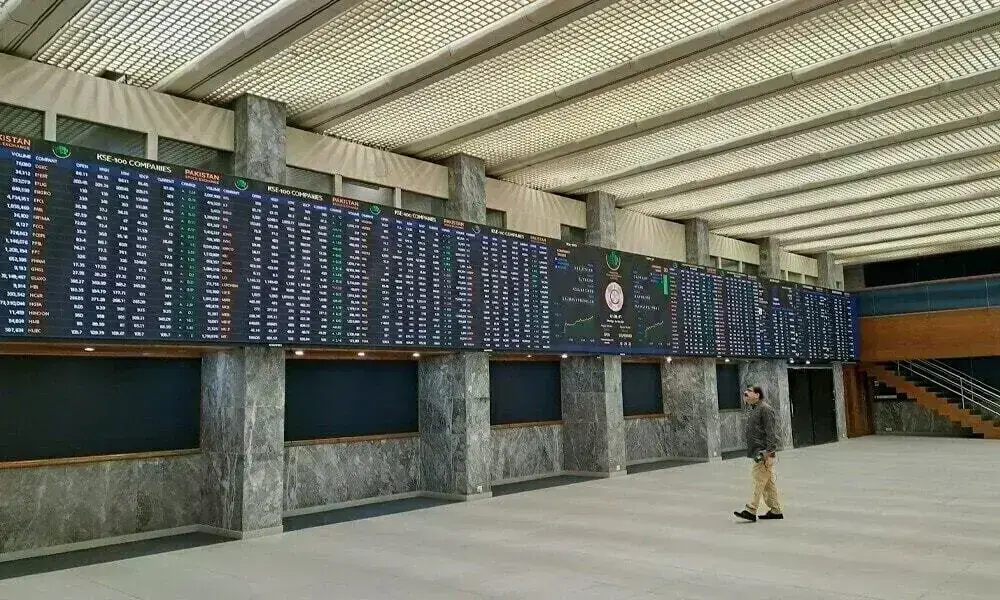
The Pakistan Stock Exchange (PSX) saw a significant drop in the KSE-100 Index during early Monday trading, with the benchmark index shedding over 200 points. At 9:45am, the KSE-100 Index was trading at 175,126.32, marking a decrease of 202.50 or 0.12%.
Selling pressure was particularly evident in key sectors such as automobile assemblers, cement, commercial banks, oil marketing companies (OMCs), and refineries. Leading index-heavy stocks, including ARL, HUBCO, PSO, FFC, MEBL, NBP, and UBL, were trading in the red.
The previous week saw the PSX under pressure, with the KSE-100 Index falling 1.3% to settle at 175,328.81 points. This decline was attributed to renewed US-Iran military skirmishes, which heightened geopolitical uncertainty, and a sharp rise in international oil prices, which added to inflation and external account concerns.
Internationally, Asian shares rallied on Monday, with the robust US jobs report seen as positive for global growth. However, the report also narrowed the odds of a rise in interest rates. Brent crude added 0.2% to reach $96.45 a barrel, having climbed almost 10% the previous week, while US crude rose 0.4% to $91.85 a barrel.
Tehran announced it will announce a restricted zone outside the Strait of Hormuz in the coming days, following US forces hitting three Iranian tankers and Iran’s Islamic Revolutionary Guard Corps launching ballistic missiles at two US Navy ships. This development raised concerns about further escalation in the region.
The risk of hawkish guidance from the European Central Bank after its rate hike kept European stocks on edge on Monday. EUROSTOXX 50 futures and DAX futures eased 0.1%, while FTSE futures were flat. On Wall Street, a U.S. holiday kept turnover light, with both S&P 500 futures and Nasdaq futures a fraction lower.
In Asia, Japan’s Nikkei rebounded 2.0% after losing a similar amount the previous week, while South Korea rallied 3.0%. MSCI’s broadest index of Asia-Pacific shares outside Japan added 0.9%.