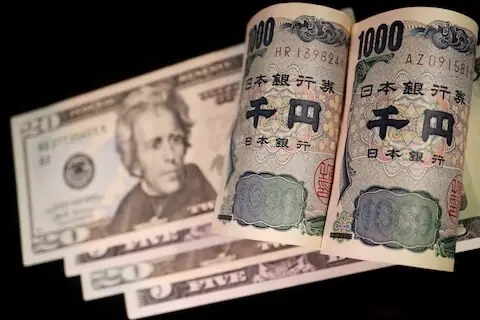
Key Takeaways
- The yen is under pressure due to a firm dollar and hawkish policies by global central banks.
- Japan's interest rates remain at a wide gap compared to major peers, supporting carry trades.
- Markets expect the yen to rise to 160 by year-end before appreciating to 156 by mid-2027.
The yen has faced downward pressure from a strong dollar, driven by hawkish policies adopted by global central banks, according to traders in the market.
Japan's central bank, the Bank of Japan (BOJ), recently hiked its interest rate, but with two dovish dissenters, creating a stark contrast with the Federal Reserve and other global central banks that are sounding hawkish and expecting further rate hikes.
Carlos Casanova, senior Asia economist at Union Bancaire Privée, noted that unless the BOJ tightens policy more rapidly than the Federal Reserve, the approximately 275-basis-point US-Japan rate differential should continue to support yen-funded carry trades.
Markets are pricing a 30% chance that the BOJ will hike its benchmark short-term rate to 1.5% in October, while a 55% chance exists for the Federal Reserve to lift its funds rate window by 25 basis points to 4% to 4.25%.
Other currency pairs remained mostly steady, with the euro trading at $1.1467 and the Australian dollar at $0.7120. Cryptocurrencies have rallied, with bitcoin reaching an eight-month high above $87,000.
Sterling traded around $1.3372, while the New Zealand dollar was near multi-month lows at $0.5708, as kiwi rates, at 2.75%, are much lower than peers.
ANZ analysts noted that higher-yielding currencies are benefiting from better carry, contributing to the kiwi's weak price action despite expectations of five more official cash rate hikes.
The yen's performance is expected to continue to be influenced by the gap in interest rates between Japan and other major economies, with forecasts predicting it to rise to 160 by year-end before appreciating to 156 by mid-2027.