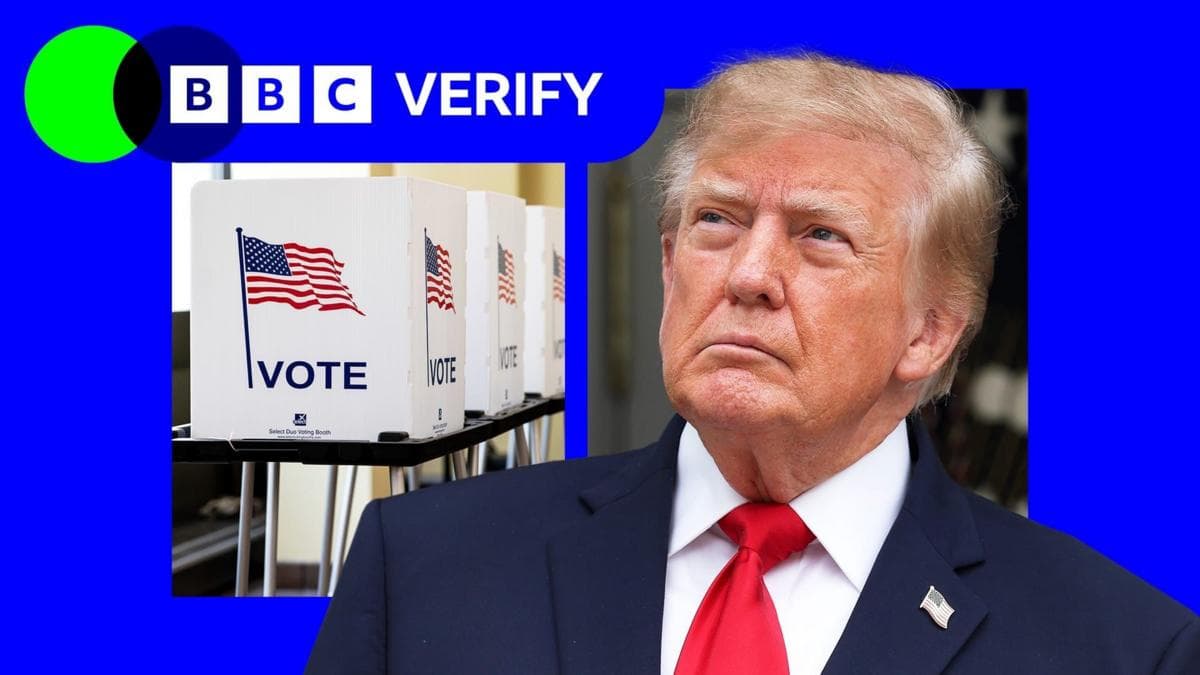
President Donald Trump offered a $1 million reward to individuals who report cases of voter fraud in the United States that lead to a conviction. Trump alleged that non-citizens and postal voting systems are subject to rampant cheating.
Approximately 48 million people used postal ballots during the 2024 presidential election. The US Supreme Court previously rejected an executive order by Trump that sought to place restrictions on postal voting.
Research from the Brookings Institute found that, on average, there were only about 4 cases of fraud for every 10 million postal votes cast between 2016 and 2022. The Heritage Foundation database recorded 325 convictions over the last 20 years resulting from the fraudulent use of postal ballots.
Oregon reported 40 fraud cases between 2000 and 2020 after the state distributed more than 100 million postal ballots. The Heritage Foundation's database also identified 24 instances where non-citizens were convicted of voting between 2005 and 2025.
Over a 30-year period, 129 people faced criminal charges and 73 cases ended in convictions for non-citizen voting. Darrell West, a senior fellow at the Brookings Institute, said, "The fact that it's illegal for non-citizens to vote is a pretty strong deterrent in the first place as many worry about their immigration status and it would be an extremely risky move to vote."
West added in an interview that there has never been evidence of enough people committing such acts to influence an election. An audit in Georgia identified 432 possible non-citizens on voter rolls over a 30-year period.
Nevada officials found that all 185 names provided by the Department of Homeland Security as suspected non-citizens were actually citizens. A software glitch in New Jersey registered roughly 6,600 non-citizens to vote between June 2023 and June 2024, though fewer than 400 of those individuals actually cast ballots.
The US Justice Department requested that California exclude 20,000 postal ballots from likely non-citizen registrants, but an appeals court rejected that request. The Justice Department charged 28 people for illegally registering to vote in California.
Since the 2024 election, 21 restrictive voting laws were enacted to create stricter identity requirements. About 21.3 million voting-age American citizens, representing roughly 9 percent of the population, lack readily available documents to prove their citizenship.
Walter Olson, an election expert at the conservative Cato Institute, said, "When scholars look at the effect of voter ID laws - either what the conservatives say on fraud or what progressive groups warn against about voter suppression - there doesn't seem to be a lot of proof that either has happened." The US Supreme Court lifted restrictions on the Trump administration using the SAVE database to verify voter citizenship.
Olson said federal databases can be invaluable for updating voter rolls if their limitations are understood. Olson noted that while the Trump plan to share information is positive, requiring states to treat the database as reliable despite its gaps is bad.
Launched in the 1980s, the SAVE database verifies eligibility for government benefits based on immigration status and contains information on naturalised citizens and non-citizens who have contacted the federal government. Trump has pushed for states to use the SAVE database to identify and remove non-citizens from voter rolls.
Last year, Trump signed an executive order directing the US Postal Service to only deliver ballots to voters on citizen lists compiled by government agencies.