Key Takeaways
- Tens of thousands of demonstrators are expected in Paris for high school student protests.
- Clashes with police have occurred, with 215 students and 715 police officers injured.
- The government and opposition have failed to reach a consensus, leading to continued unrest.
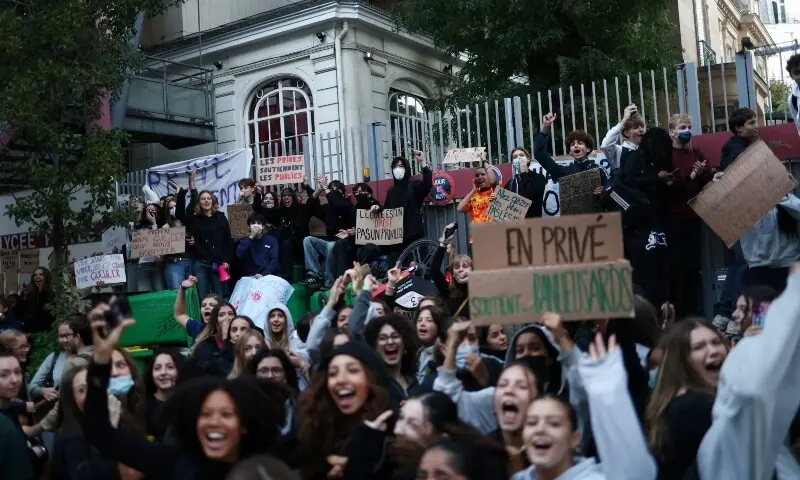
Tens of thousands of demonstrators are expected to take to the streets of Paris on Tuesday as France’s powerful trade unions join high school students in a wave of protests. The students, primarily 15- to 17-year-olds, have been blockading hundreds of high schools since late September, complaining of missing teachers, overloaded timetables, and dilapidated classrooms and buildings.
While many protests have been peaceful, some demonstrators have engaged in destructive acts, including lighting dustbin fires and damaging bus shelters. Clashes with riot police have also occurred, with batons, tear gas, and riot-control rounds used by the authorities. The unrest has escalated, with 24 schools burned or ransacked and over 5,000 people arrested, 87% of them minors.

The government has reported 215 students and 715 police officers injured since the start of the movement. A 15-year-old student reportedly lost a hand after picking up a sting-ball grenade fired by riot officers, according to a police union source. The unrest has erupted with just months to go before the 2027 election, which will choose a successor to centrist President Emmanuel Macron.
Prime Minister Sebastien Lecornu’s office has called for peaceful gatherings, urging a return to a structured, legal, and democratic form of opposition. The head of the CGT labour union, Sophie Binet, has stated that its members would be there to protect high school students. The government has accused the hard-left France Unbowed (LFI) party of being behind the movement, while the LFI presidential candidate Jean-Luc Melenchon has strongly supported the protests, calling for non-violent methods.
Amnesty International has accused the French authorities of using disproportionate force against the protesters, citing alarming concerns about the use of tear gas, batons, and policing techniques. The police have launched 10 internal investigations into allegations of brutality since the protests started, according to Interior Minister Laurent Nunez.
The government has sought to address the grievances, but the hard-left France Unbowed party has been accused of orchestrating the movement. Veteran LFI presidential candidate Jean-Luc Melenchon has strongly supported the protests, while calling for non-violent methods. Since the start of the movement, 24 schools have been burned or ransacked, and over 5,000 people, 87% of them minors, have been arrested.
The breakdown in parleys between the government and opposition has pushed the situation into even more chaotic territory. The opposition, led by the hard-left France Unbowed party, has insisted that its protest is to seek a lawful resolution to its grievances, most of which pertain to the implementation of the August 18 Supreme Court order. The government has signalled a zero-tolerance stance as the twin cities have remained highly barricaded over the last three weeks.
The government has accused the opposition of moving the goalposts, while the opposition has accused the government of unwillingness to allow a meeting with the imprisoned PTI leader, Imran Khan. The K-P government has also insisted that it 'should be on board' regarding decisions on counter-terrorism operations in the province. The government has also been accused of pressuring the opposition to call off their long march as a pre-condition.