Key Takeaways
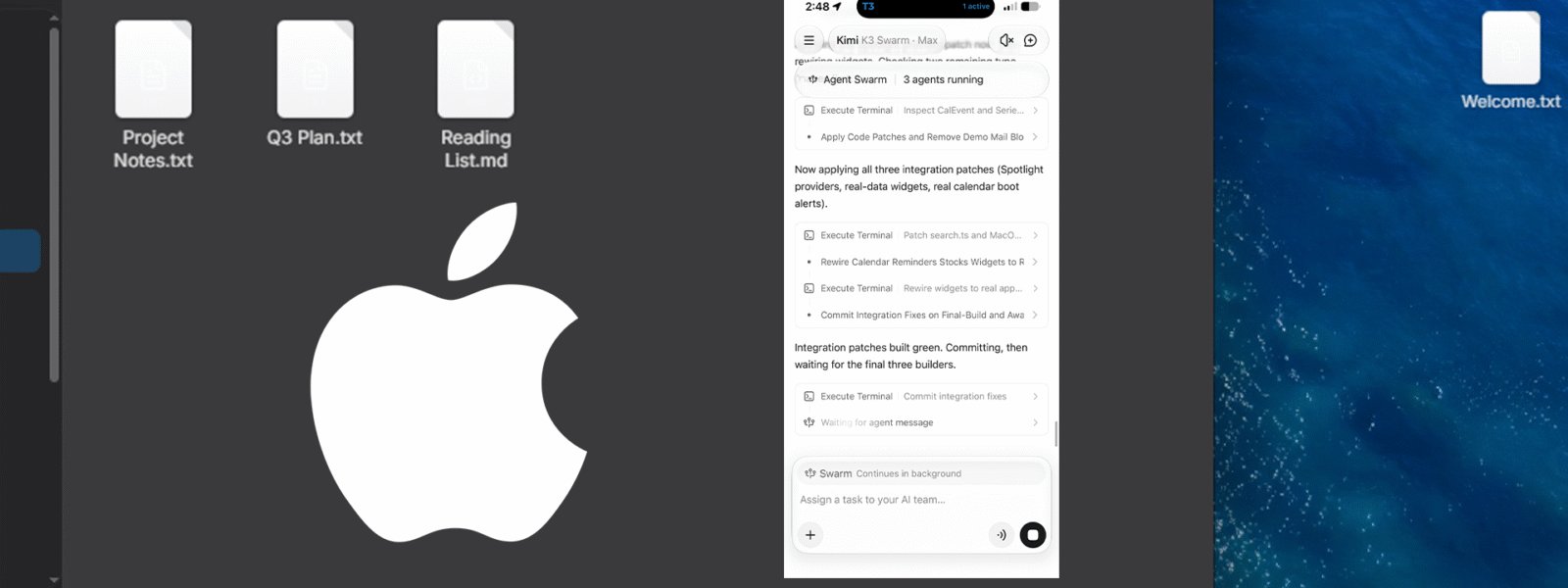
- China’s new AI model, Kimi K3, generated a functional macOS-style web application.
- The project took over three hours and consumed 60% of the user's monthly credits.
- While resembling Apple’s design, it is not an actual macOS operating system.
China has unveiled a groundbreaking artificial intelligence (AI) model that can create complex software applications without human coding. The latest release from Moonshot AI, Kimi K3, demonstrated its capabilities by generating a web application that closely mimics the look and feel of Apple’s upcoming macOS 'Golden Gate'.
According to Weinbach, an analyst who worked on the project, he prompted Kimi K3's Agent Swarm to recreate the new macOS version with Liquid Glass effects and native-style applications running within a browser. The entire process took approximately three hours and 20 minutes, consuming nearly half of his monthly credit allowance.
The resulting application is visually indistinguishable from Apple’s operating system, featuring working apps and the company's distinctive visual design language. However, it should be noted that this is not an actual macOS; instead, it is a web application designed to simulate its appearance and functionality.
Kimi K3, the latest flagship AI model from Moonshot AI, was released this week with capabilities aimed at long-running coding and agent-based tasks. It supports a context window of up to one million tokens and includes an Agent Swarm system that enables multiple AI agents to work on different parts of a project simultaneously.
The model has already garnered attention for its exceptional coding performance. According to the AI benchmarking platform Arena, Kimi K3 topped the Frontend Code Arena, achieving a 76% pairwise win rate when compared with competing models on similar tasks.
This development highlights the rapid advancement in AI-assisted software development. While the experiment showcases the potential of these new systems, it also underscores that significant computing resources are still required to achieve such results.
The macOS-style demo has sparked discussions across the AI industry about the future of coding and software creation. As AI models continue to evolve, they may increasingly be able to plan, write, debug, and assemble complete software projects from a single instruction.