Key Takeaways
- Norway uses white paint and water spraying to cool airport runways.
- Drones and AI sensors are employed to inspect railway tracks for safety.
- Heatwaves pose significant challenges to Europe's aging infrastructure.
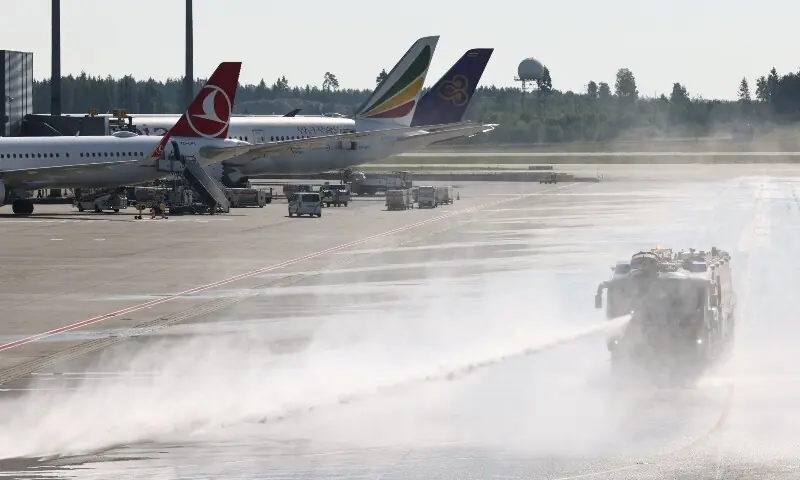
As temperatures soar across Europe, countries are implementing a range of innovative solutions to protect their critical infrastructure from the damaging effects of extreme heat. In Norway, workers at Oslo airport have resorted to using white paint and water spraying on runways to prevent damage caused by high temperatures. The airport's operating engineer, Jrn Arvid Remark, explained that 'the asphalt must withstand both extreme cold and fairly warm temperatures,' highlighting the need for new materials and techniques.
The issue extends beyond airports; Europe’s railways are also facing unprecedented challenges. According to a recent report from the European Union, more than 70% of rail managers have reported growing disruptions due to extreme weather events. Between 2015 and 2024, weather-related interruptions amounted to one to three years of railway service across the region. High temperatures can cause tracks to expand, leading to failures in points, signals, and power systems.
While heat itself poses a significant threat, it is the accompanying extreme weather events such as thunderstorms, strong winds, and landslides that are causing the most disruption. Professor Oliviero Baccelli from Milan’s Bocconi University noted, 'The most critical issue for rail networks is not the heat itself, but the thunderstorms, strong winds, and landslides that often follow heatwaves.' Italy has already experienced significant disruptions to its railway network, particularly on Alpine routes.
To mitigate these challenges, European countries are turning to advanced technologies. Drones equipped with AI sensors are being used to inspect railway tracks for safety and efficiency. John Lawrence, chair of the IET Railway Technical Network, stated that 'many rail components and systems were in essence frozen in time.' He added that operators are exploring more stable sleeper designs and technologies such as AI and drones to speed up track inspections and monitoring.
The economic impact of extreme weather events is also significant. A 2025 report by leading central banks estimated that severe weather events, including heatwaves, droughts, and floods, could cut euro zone GDP by as much as 4.7% by 2030. Chris Dodwell, co-head of the sustainability centre at Impax Asset Management, warned that 'heatwaves, once rare, are becoming regular events.'
In Britain, Network Rail is exploring ways to adapt its infrastructure to cope with higher temperatures. The rail network faces particular challenges due to much of its infrastructure being designed for a narrower temperature range than networks in southern Europe. Lawrence emphasized the need for cost-effective solutions: 'It would be a huge cost to heat-proof entire networks.' However, he added that operators are exploring new technologies and designs to address these issues.
The use of white paint and water spraying at Oslo airport is just one example of how countries are adapting their infrastructure to cope with rising temperatures. As Europe continues to experience more frequent and intense heatwaves, it is clear that innovative solutions will be essential in protecting critical infrastructure.
'The most critical issue for rail networks is not the heat itself, but the thunderstorms, strong winds, and landslides that often follow heatwaves.'
Oliviero Baccelli, Professor at Milan’s Bocconi University
'It would be a huge cost to heat-proof entire networks.'
John Lawrence, Chair of the IET Railway Technical Network