Key Takeaways
- The KSE-100 Index gained over 800 points during the opening minutes of trading on Wednesday.
- Buying interest was observed in key sectors including automobile assemblers, cement, and commercial banks.
- The Ministry of Finance unveiled a Strategic Action Plan for Pakistan’s Local Currency Bond Market.
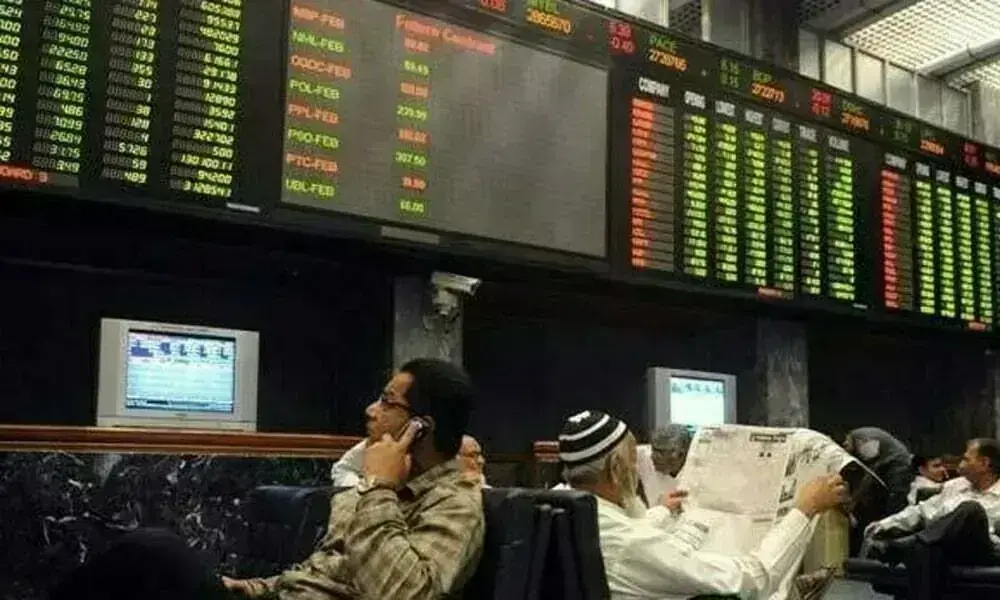
At 9:40am on Wednesday, the Pakistan Stock Exchange (PSX) saw a surge in buying interest, with the benchmark KSE-100 Index gaining over 800 points. The index was hovering at 170,449.17, up by 848.77 points or 0.50%.
Buying was observed across various sectors, including automobile assemblers, cement, commercial banks, fertiliser, oil and gas exploration companies, OMCs, and refineries. Major index-heavy stocks such as ARL, HUBCO, MARI, OGDC, PPL, POL, HBL, MCB, MEBL, and NBP traded in the green.
In a significant development, the Ministry of Finance (MoF) on Tuesday unveiled a Strategic Action Plan for Pakistan’s Local Currency Bond Market (LCBM) under its International Monetary Fund (IMF)-supported programme. The plan aims to address market bottlenecks, target deeper secondary-market liquidity, and broaden the investor base.
On Tuesday, the PSX experienced renewed selling pressure as rising global crude prices and persistent Middle East geopolitical tensions triggered a late-session sell-off. The benchmark KSE-100 Index fell 825.22 points, or 0.48%, to close at 169,600.41 points.
Internationally, global bonds wobbled on Wednesday and were set for their worst month in years, hit by a toxic mix of deteriorating government finances, a glut of issuances, and rising inflation. The seven-month-old US-Israeli war on Iran kept energy costs elevated, affecting global markets.
Despite the rise in borrowing costs, stocks fared better, largely unfazed by the surge in bond yields. MSCI’s broadest index of Asia-Pacific shares excluding Japan rose 0.2% in early trading and was on track for a monthly fall of just over 1%. Japan’s Nikkei rose 0.9% and was set to end the month little changed, while South Korea’s Kospi was headed for a monthly gain of 1.4%.
The rise in borrowing costs has been a key focus for investors, as sovereign yields are an anchor for global markets, a reference price for investing in riskier stocks, and a benchmark for mortgages and corporate borrowing. While a persistently higher risk-free rate increases the cost of refinancing for companies and weighs on growth, its impact on stocks has thus far been relatively limited.