Key Takeaways
- Prime Minister Shehbaz Sharif has approved duty-free imports of high-yield livestock breeds.
- The move aims to increase livestock exports and reorganize the sector along corporate lines.
- Authorities are tasked with preparing a roadmap to eliminate livestock diseases and improve export infrastructure.
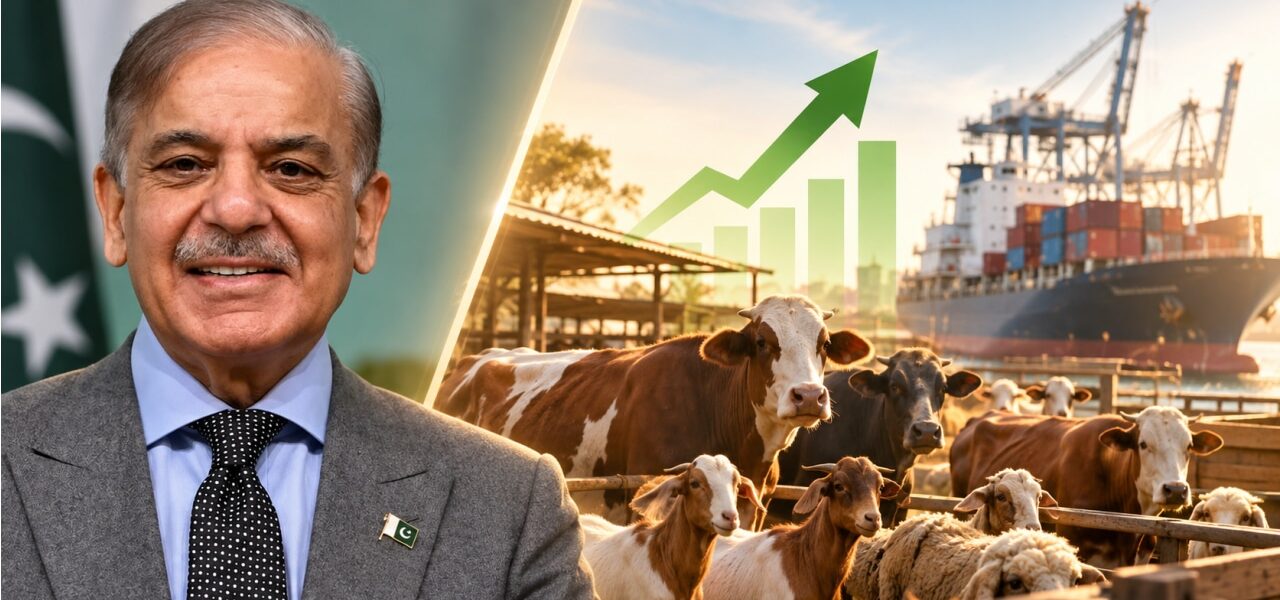
Prime Minister Shehbaz Sharif has approved a plan to boost livestock exports by importing high-yield breeds, according to a statement from ProPakistani. The plan involves establishing specialized farms for raising these imported animals, which will then be exported.
The prime minister directed that livestock imported for these specialized farms be exempted from duties, aiming to make the process more cost-effective and efficient.
To ensure the quality and traceability of the livestock, the government has ordered the introduction of a modern animal-tagging system. This system will help in monitoring the health and movement of the animals, ensuring they meet international standards.
In a bid to reorganize the livestock sector, the prime minister called for the involvement of private-sector experts. The goal is to modernize the sector and improve its export potential, which currently stands at 63.6 percent of the agricultural economy.
The Ministry of National Food Security and Research has been directed to work with provincial governments to eliminate livestock diseases. Specific targets have been set for the eradication of foot-and-mouth disease within two weeks.
Pakistan’s livestock sector is significant, with around 245 million animals worth Rs. 5.5 trillion, contributing 14.97 percent to the national economy. Annual production includes 74.69 million tonnes of milk and 6.31 million tonnes of meat, supporting 8 million rural households.
Despite its potential, the sector faces challenges such as small-scale farming and fragmented supply chains. The government is working on measures like international certification of slaughterhouses and third-party validation to ensure compliance with global standards.
Measures to improve the livestock value chain include feedlot farming, cold-chain infrastructure, deboning, and the development of value-added products. The government is also focusing on export infrastructure, with the aim of increasing meat exports, currently at $530 million in 2025-26, to Gulf markets and other potential destinations like Malaysia, Saudi Arabia, and China.
Other initiatives include animal disease surveillance, prevention, and traceability, the creation of foot-and-mouth disease-free zones, and vaccination programs. Digital disease surveillance and export-grade farms are also part of the plan to enhance the sector’s competitiveness.