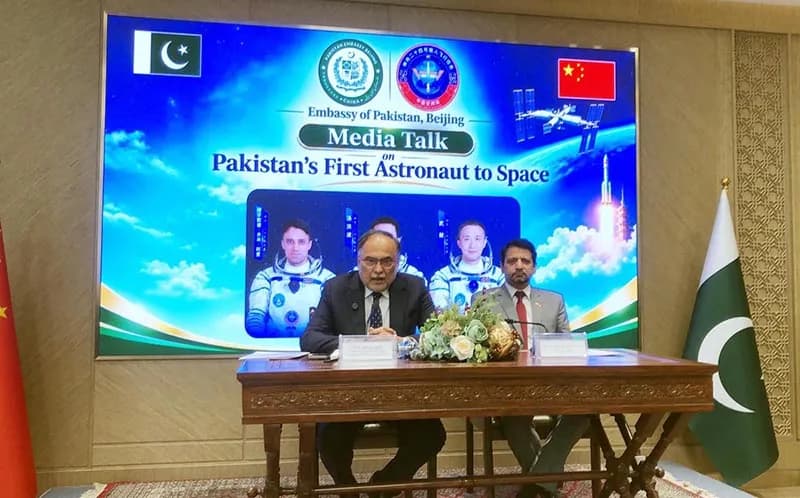
BEIJING: Minister for Planning, Development & Special Initiatives Ahsan Iqbal said the space mission of Muhammad Zeeshan Ali represents a milestone that offers a glimpse of the future for millions of young Pakistanis. Iqbal said the mission may have its greatest impact by inspiring young people to pursue space science, scientific exploration and STEM education.
Iqbal spoke after witnessing the Shenzhou-24 launch. He said, "It was not the person of Zeeshan Ali, it was the country Pakistan that was also flying with him."
The mission follows a long history of space cooperation between the two nations. Pakistan established the Space and Upper Atmosphere Research Commission (SUPARCO) in 1961. Chinese launch services supported the PAKSAT-1R communications satellite in 2011 and the PRSS-1 remote-sensing satellite in 2018.
Iqbal recalled discussing the prospect of sending a Pakistani astronaut into space with Chinese counterparts in 2017 and 2018. SUPARCO and the China Manned Space Agency signed an agreement for the first Pakistani astronaut mission in February 2025.
Two candidates, Zeeshan Ali and Khurram Daud, completed training in China. The preparation included technical and physical training, learning Chinese, and building relationships with Chinese counterparts. Iqbal praised the provision of halal meals for the astronauts during their stay.
Ambassador of Pakistan to China Dr. Syed Ali Asad Gillani said Ali could return home as an "icon" and "role model" for young people. Gillani plans to arrange for the astronaut to meet students at the Pakistani embassy school after the mission.
Pakistan hopes to send a lunar rover on a future Chinese lunar mission and aims to develop its own capability for a lunar landing by 2035. Gillani proposed training at least 10,000 Pakistani PhD graduates at Chinese universities over the next decade in fields including space science, artificial intelligence and materials science.