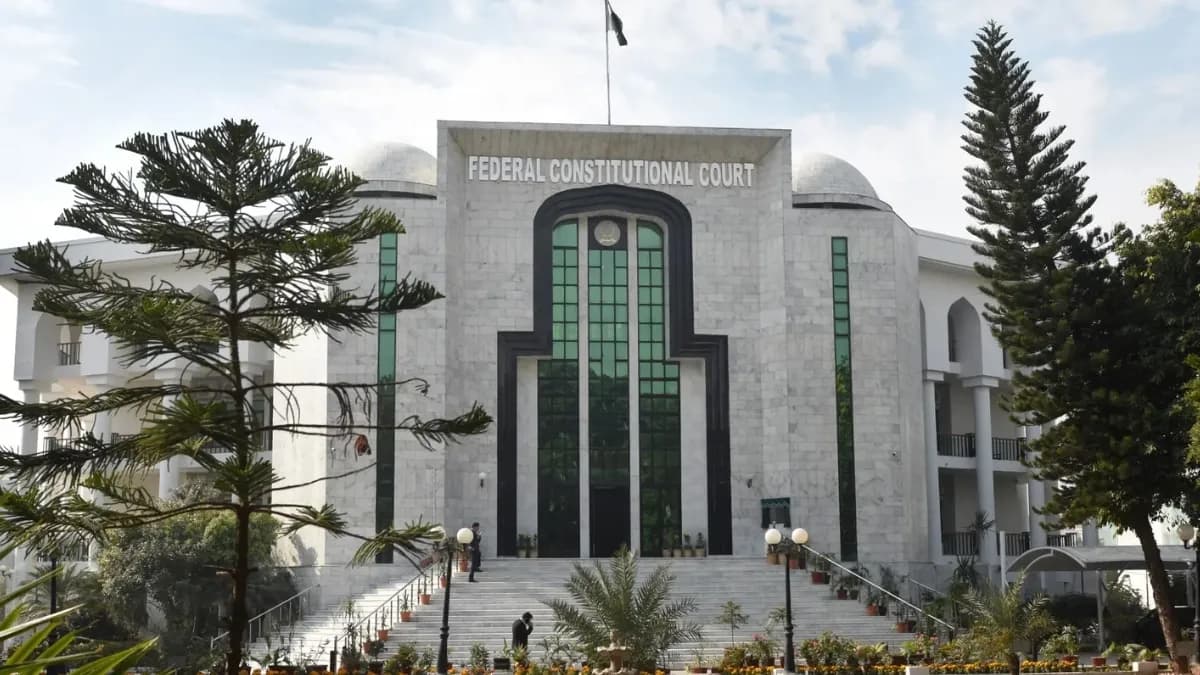
The Federal Constitutional Court has ruled that inheritance records cannot deprive an individual of their rightful share under Islamic law. In an 11-page judgment, the court clarified that cousins may be entitled to remaining property under specific conditions.
The two-member bench, consisting of Chief Justice Aminuddin Khan and Justice Ali Baqar Najafi, upheld a November 6, 2024, decision by the Lahore High Court. The court dismissed appeals filed by Kaneez Haider regarding a property inheritance dispute involving the estate of Muhammad Asghar.
Chief Justice Aminuddin Khan authored the judgment, which observed that inheritance rights cannot be determined solely on the basis of family ties or blood relationships. Instead, the court ruled that property must be distributed according to Islamic inheritance law and its established legal categories.
The court found that after prescribed shares are distributed among the widow and sisters, the remaining property belongs to eligible residuary heirs, known as Asabah. The bench further clarified that the principle of Radd, which allows for the redistribution of remaining property among eligible heirs, cannot be applied when a legally entitled residuary heir exists.
In the specific case of Muhammad Asghar’s estate, the court upheld the inheritance claim of his paternal cousin, ruling that he was entitled to the remaining share of the property. The judgment emphasized that revenue records and procedural formalities cannot change an individual’s inheritance rights or validate an unlawful distribution of property.
According to the ruling, Asghar’s widow is entitled to one-fourth of his estate, while his two full sisters are collectively entitled to two-thirds. The remaining one-twelfth share will go to an eligible residuary heir.
The bench also noted that inheritance laws differ between Sunni and Shia schools of thought, emphasizing that property must be distributed according to the Muslim personal law applicable to the deceased. The court concluded that the appellant failed to establish any legal error that would justify interference with the Lahore High Court’s decision.