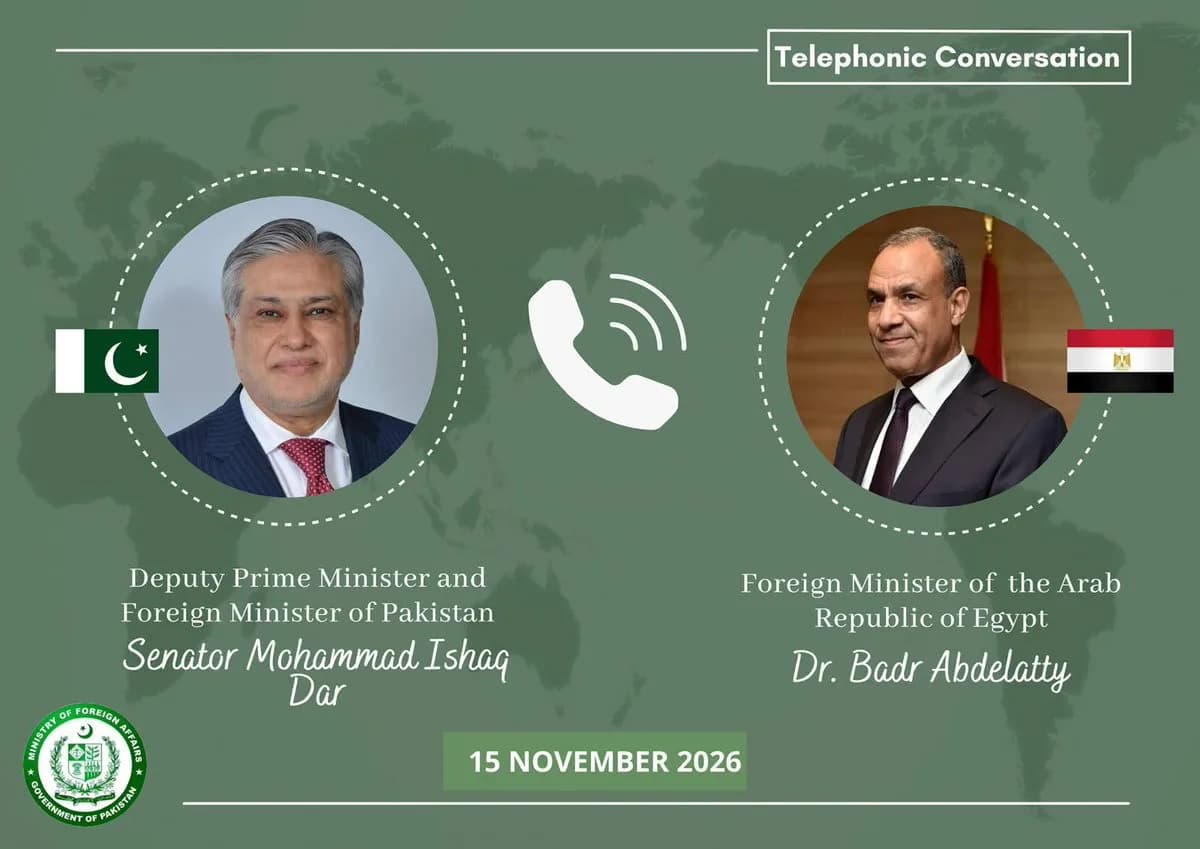
Deputy Prime Minister and Foreign Minister Senator Mohammad Ishaq Dar responded positively to an invitation from Egyptian Foreign Minister H.E. Dr. Badr Abdelatty for Prime Minister Shehbaz Sharif to visit Cairo. The response was given during a telephone conversation between the two officials on November 15, 2026.
The Foreign Office stated that Dar and Abdelatty exchanged views on international and regional developments. The two ministers also discussed the forthcoming R4 and R4+E4 meetings in Europe.
According to the Foreign Office, “Both Ministers underscored the importance of strengthening coordination on regional issues and advancing efforts for peace and stability.” The ministers agreed to “maintain close contact and continue consultations on matters of mutual interest.”
Pakistan and Egypt have stepped up high-level diplomatic engagement in recent months, with both sides seeking closer cooperation on regional issues, trade and defence. During Egyptian Foreign Minister Badr Abdelatty's visit to Islamabad in November 2025, the two countries agreed to establish a Pakistan-Egypt Business Council and Business Forum, facilitate visa access for Pakistani businesses and double the number of scholarships for Pakistani students at Al-Azhar University in Cairo.
On September 22, the foreign ministers of Pakistan, Egypt, Saudi Arabia and Türkiye last met on the sidelines of the 81st session of the United Nations General Assembly in New York to discuss regional developments and efforts to promote peace and stability. During the meeting, the four countries condemned attacks against Saudi Arabia, including recent Houthi attacks, and reaffirmed their support for the kingdom’s sovereignty, territorial integrity and security. They also stressed the importance of dialogue and diplomacy, called for the Islamabad Memorandum of Understanding to be upheld to help secure lasting regional peace and stability, and reiterated support for the Palestinian people’s right to self-determination.
The Istanbul meeting, however, assumes added significance because it will be the first major R-4 engagement since Pakistan, Saudi Arabia and Türkiye signed the Makkah Joint Defence Agreement on August 7. The agreement commits the three countries to collective defence, with an armed attack against one member to be treated as an attack against all. Pakistan and Türkiye have stressed that the pact is defensive in nature and is not directed against any particular country. The agreement also envisages deeper military coordination, joint exercises and cooperation in defence technology. Egypt's potential participation had emerged as an important question in the run-up to the Makkah agreement. Turkish officials had indicated that Cairo could eventually join the new defence arrangement, given its military weight and strategic importance in the region. However, Egypt did not become a signatory when Pakistan, Saudi Arabia and Türkiye concluded the pact in Makkah.