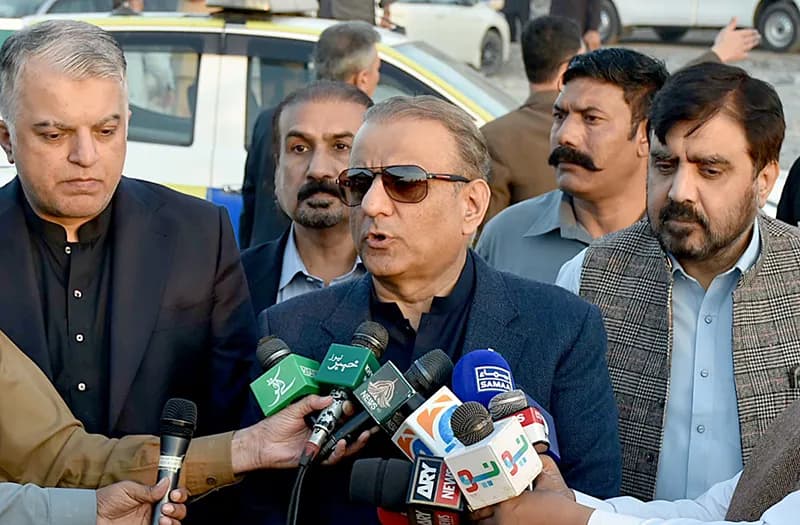
Federal Minister for Communications Abdul Aleem Khan stated that Pakistan serves as the optimal bridge connecting Central Asia, South Asia, China, and the Middle East. He made these remarks during a virtual address to the United Nations Economic and Social Commission for Asia and the Pacific (ESCAP) Ministerial Conference on Transport, which took place in Bangkok from November 17–20, 2026.
Addressing transport ministers and delegates, Khan emphasized that the main goal of regional integration is the seamless movement of people, goods, and services. He called for the creation of alternative trade routes to ensure supply chain resilience instead of depending on a single country or corridor. Khan noted that removing trade barriers would significantly strengthen regional supply chains.
The Minister highlighted Pakistan’s geostrategic position, pointing out that the country's major seaports—Karachi, Port Qasim, and Gwadar—provide the shortest and most viable maritime access to landlocked Central Asian Republics.
Regarding specific projects, Khan described the Quadrilateral Traffic in Transit Agreement (QTTA) as a vital framework for regional cargo transit. He reported that close cooperation is currently underway on the Kazakhstan-Turkmenistan-Afghanistan-Pakistan railway project, and that feasibility studies for the Uzbekistan-Afghanistan-Pakistan rail link are actively progressing.
On land infrastructure, Khan noted that keeping the Karakoram Highway (KKH) open year-round has substantially boosted trade links with China and Central Asia. He added that construction is advancing on the Thakot–Raikot section under CPEC. Furthermore, Khan stated that Pakistan has secured funding from the Islamic Development Bank (IsDB) and the OPEC Fund for three sections of the M-6 Motorway.
Khan also briefed the conference on border modernization and trade facilitation. He highlighted reforms in digital trade through the Pakistan Single Window (PSW) and the Web-Based One Customs (WeBOC) system. Under the Central Asia Regional Economic Cooperation (CAREC) program, state-of-the-art facilities have been established at the Torkham and Chaman border crossings.
According to Khan, the deployment of e-gates and modern scanners is projected to reduce border clearance times by 65 percent, while measures for cross-border passenger facilitation aim to cut processing times by up to 90 percent. He concluded by reaffirming Pakistan's commitment to a safe, sustainable, and integrated regional transport network for economic resilience and shared prosperity.