Key Takeaways
- Prime Minister Shehbaz Sharif has approved a new draft auto policy.
- The policy proposes a 10% levy on cars with engine capacities above 2,000cc.
- Vehicles with engine capacities below 1,000cc and two/three-wheelers are exempt.
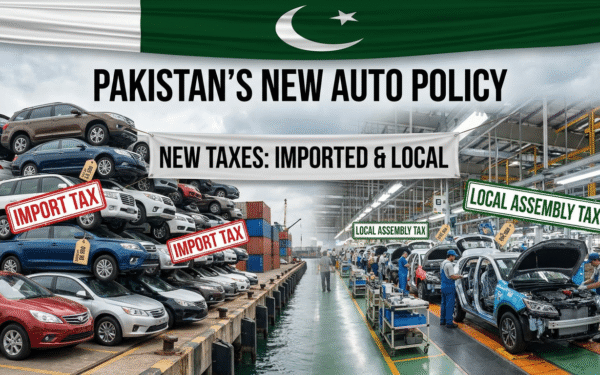
The government of Pakistan has approved a new draft auto policy that proposes a new Automotive Development Levy on imported and locally manufactured vehicles, according to sources. This levy will apply to cars with engine capacities between 1,001cc and 2,000cc, with a 2% levy, and those above 2,000cc will face a 10% levy.
Vehicles with engine capacities below 1,000cc, as well as two- and three-wheelers and agricultural tractors, will be exempt from the levy. The policy also outlines specific rates for other vehicle categories, including prime movers (excluding agricultural tractors), trucks and light commercial vehicles (LCVs), buses, and vans, all of which will carry a 2% rate.
The draft policy’s proposed rates are comprehensive, covering both imported and locally manufactured internal combustion engine vehicles. However, the final implementation details, including the basis on which the rates will be calculated and the effective date, have yet to be determined. These details will ultimately determine the impact on car prices.
The policy aims to support the development of the automotive sector by imposing a levy on high-end cars, which are often imported. The government hopes that this measure will encourage the production and use of more affordable vehicles, benefiting the broader population.
The proposed rates are part of a broader strategy to modernize the automotive industry in Pakistan. The government believes that this levy will help in promoting the use of more fuel-efficient and environmentally friendly vehicles, while also generating revenue for the state.
The draft policy has been approved by Prime Minister Shehbaz Sharif, who has emphasized the need for a balanced approach to the automotive industry. The government is committed to ensuring that the new levy is implemented in a manner that is fair and transparent, and that it does not disproportionately affect the purchasing power of the average Pakistani citizen.
The proposed levy is expected to generate significant revenue for the government, which can be used to fund various development projects and initiatives. However, the exact amount of revenue and its distribution are still under consideration.
The implementation of the new levy is expected to have a mixed impact on the automotive market. While it may discourage the purchase of high-end cars, it could also encourage the production and use of more affordable vehicles, which could benefit the broader population.