Key Takeaways
- Finance Minister Muhammad Aurangzeb has ruled out pursuing consumption-led economic growth.
- Pakistan will continue with tariff reforms to improve industrial competitiveness.
- Aurangzeb warns against repeating import-dependent growth that led to balance-of-payments problems.
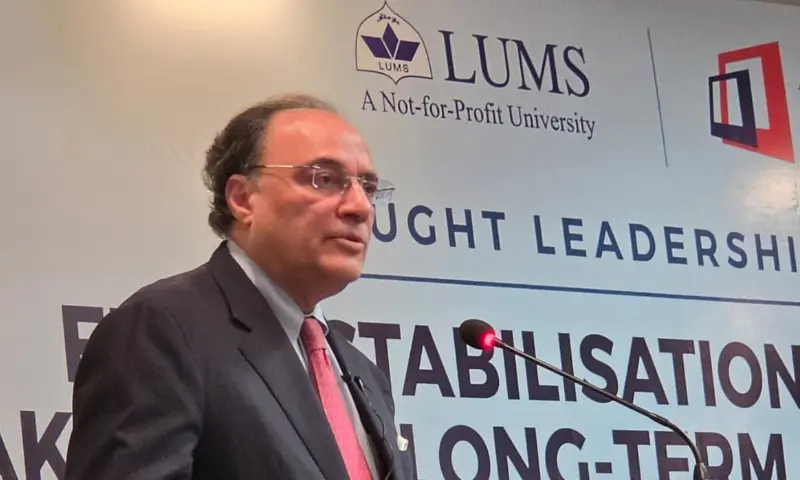
Finance Minister Muhammad Aurangzeb has clarified that Pakistan will not pursue a consumption-led growth strategy, instead opting for a sustainable, export-driven expansion. Speaking at an event at the Lahore University of Management Sciences (Lums), Aurangzeb emphasized the need to avoid repeating the cycle of import-dependent growth that previously caused balance-of-payments issues and forced the country to seek international support.
Aurangzeb stated, 'We are very clear: no matter how much pressure there is, we are not going to go for liquidity-fuelled, consumption-led growth.' He added that Pakistan needs to avoid another cycle where temporary economic activity leads to a balance-of-payments crisis.
The finance minister highlighted that the government has attempted to provide a direction towards export-led growth in the latest budget through measures such as the elimination of super taxes, reductions in tax slabs, and financing for exporters at 4.5 per cent. He also noted that the government is committed to continuing tariff reforms, primarily to reduce the cost of raw materials and intermediate goods for exporters, despite concerns over the timing of the measures.
Aurangzeb further stressed that economic growth must generate employment, pointing to the contrast between Pakistan’s growth trajectory and that of its neighbour, where growth of 7 to 8 per cent has not translated into sufficient job creation. He emphasized that the sectors driving growth must also address unemployment.
Reflecting on discussions at international forums, Aurangzeb noted that the global economy remains resilient but faces an uncertain and worrying outlook. He identified growing differences in economic fortunes between oil-exporting and oil-importing countries, as well as economies benefiting from artificial intelligence, as key themes in discussions on global growth.
Aurangzeb warned that energy shocks and the El Nino weather phenomenon are intensifying and contributing to food-security concerns in some parts of the world. He also highlighted high debt levels, limited fiscal space in some economies, and the growing importance of digital infrastructure and labour-market preparedness for artificial intelligence.
As trade fragmentation and geopolitical polarisation intensify, regional corridors and regional blocs are emerging as significant opportunities. Aurangzeb stated that these developments could be particularly important for Pakistan.
The finance minister also mentioned that the twin deficits in Pakistan have narrowed, but did not provide specific figures. He emphasized the government's commitment to continuing tariff reforms and export-led growth strategies to ensure sustainable economic development.
We are very clear: no matter how much pressure there is, we are not going to go for liquidity-fuelled, consumption-led growth.
Muhammad Aurangzeb, Finance Minister