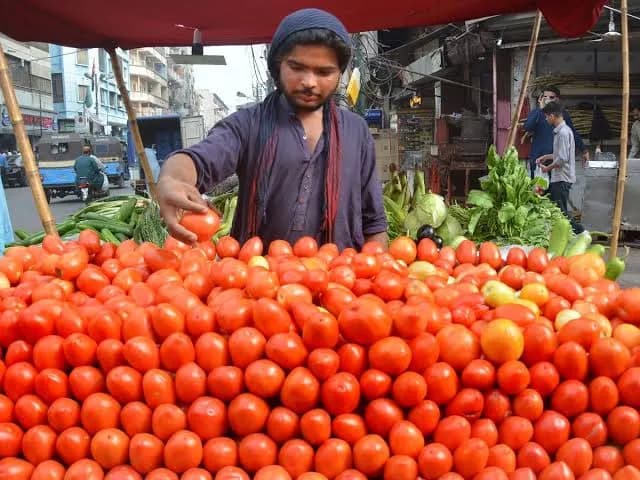
The Sensitive Price Index (SPI)-based inflation saw a decrease of 0.11 percent during the week that ended on November 26. According to data released on Friday by the Pakistan Bureau of Statistics (PBS), this decline was primarily driven by a downward trend in the prices of tomatoes, which fell by 23.92 percent, onions, which dropped by 21.27 percent, and Liquefied Petroleum Gas (LPG), which was down by 7.78 percent.
Other items that experienced a price reduction included petrol, which declined by 2.48 percent, diesel by 1.99 percent, pulse masoor by 0.68 percent, sugar by 0.24 percent, and both bananas and pulse mash by 0.12 percent each.
Conversely, the PBS data showed that several household items saw price hikes during the same week. Wheat flour increased by 5.72 percent, while electricity for Q1 rose by 5.43 percent. Eggs went up by 4.36 percent, chicken by 4.14 percent, and garlic by 1.54 percent. Other increases included rice basmati broken by 0.79 percent, potatoes by 0.78 percent, pulse gram by 0.57 percent, match box by 0.47 percent, plain bread by 0.44 percent, firewood by 0.24 percent, and washing soap by 0.19 percent.
Out of 51 items in the basket, the prices of 20 items, making up 39.22 percent of the SPI, recorded an increase. The prices of 9 items, or 17.65 percent of the basket, saw a reduction, while the prices of 22 items, representing 43.13 percent of the basket, remained stable.
On a year-on-year (YoY) basis, the trend depicts an increase of 9.49 percent. This is mainly driven by a sharp escalation in the prices of LPG, which rose by 67.49 percent, wheat flour by 53.53 percent, chicken by 30.10 percent, electricity for Q1 by 29.33 percent, diesel by 22.36 percent, petrol by 18.34 percent, chili powder by 15.55 percent, mutton by 14.59 percent, plain bread by 12.85 percent, beef by 11.09 percent, pulse gram by 9.62 percent, and fresh milk by 8.96 percent.
However, on a YoY basis, the price of sugar declined by 26.56 percent, potatoes by 23.04 percent, tomatoes by 15.91 percent, eggs by 11.78 percent, salt powder by 8.78 percent, pulse moong by 7.57 percent, pulse masoor by 7.29 percent, and gur by 5.71 percent.
The PBS data also broke down the SPI by income groups. Households with a monthly income of up to Rs17,732 registered a reduction of 0.09 percent, with the SPI falling from 359.45 points to 359.13 points. For the Rs17,733-22,888 income group, the SPI went up by 0.12 percent, rising from 361.32 to 361.74 points.
The SPI for households with monthly earnings of Rs22,889-29,517 registered a reduction of 0.01 percent, moving down from 381.53 to 381.50 points. For the Rs29,518-44,175 bracket, the SPI fell by 0.10 percent, going down from 367.74 to 367.37 points. The highest income group, Rs44,175 and above, recorded a reduction of 0.28 percent, taking the SPI down from 368.29 to 367.27 points. The combined SPI plunged from 370.47 points to 370.04 points, reflecting an overall reduction of 0.11 percent.