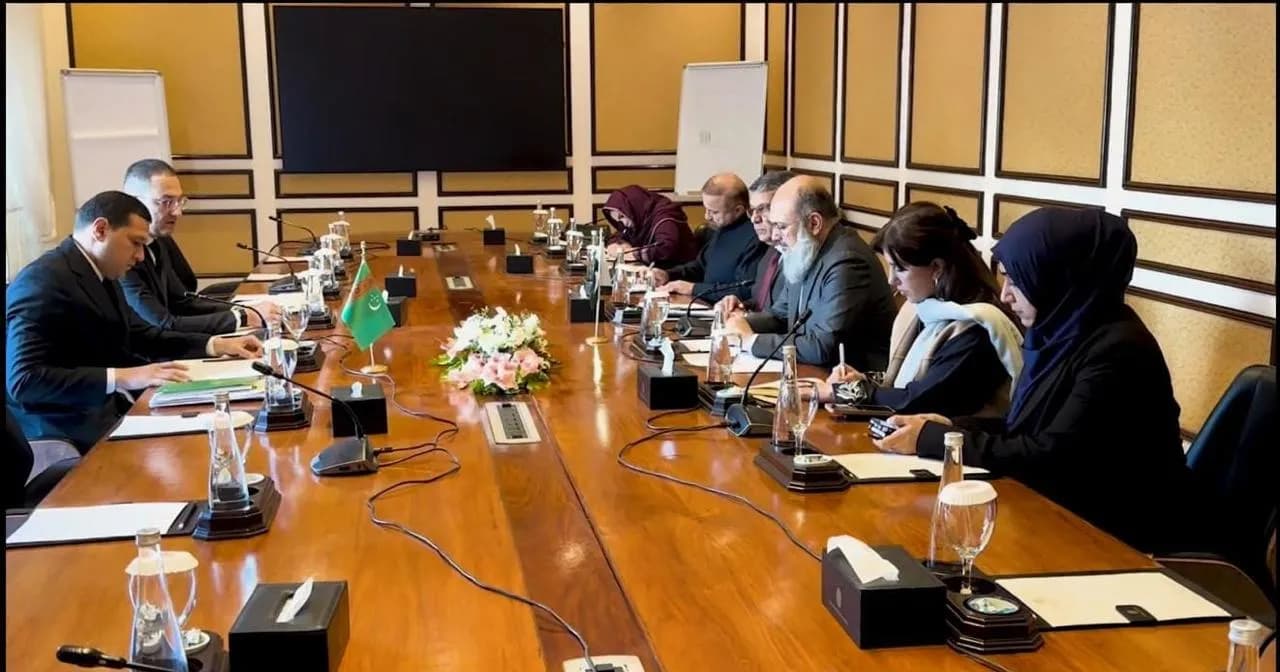
Federal Minister for Commerce Jam Kamal Khan met with Turkmenistan’s Minister of Trade and Foreign Economic Relations, Dortguly Suleymanov, to discuss measures for expanding bilateral trade and strengthening regional connectivity. The meeting took place in Islamabad on November 17, ahead of the sixth session of the Pakistan–Turkmenistan Joint Intergovernmental Commission.
Jam Kamal Khan emphasized the importance of turning bilateral relations into practical commercial partnerships, specifically in manufacturing, logistics, food processing, agriculture, and textiles. He noted that rising international freight costs and disruptions to traditional trade routes have made regional economic integration more important. He observed that Pakistan and Turkmenistan are well positioned to benefit from trade opportunities linking the Middle East, South Asia, and Central Asia.
Jam Kamal Khan proposed exploring direct flights between Islamabad and Ashgabat, as well as chartered cargo services for perishable food and agricultural products. He noted that the short flying distance between the two capitals could provide a significant advantage for time-sensitive exports. Minister Suleymanov acknowledged the importance of improved air connectivity and indicated the proposal could be discussed further with aviation authorities during the upcoming commission meeting.
Regarding overland connectivity, Jam Kamal Khan highlighted the expanding operations of Pakistan’s National Logistics Corporation (NLC) in Central Asian markets and its growing fleet of vehicles. He stressed the need to facilitate cross-border movement, explore alternative trade corridors, and address logistical challenges. The discussion also included possible alternative routes for Pakistani marble and other exports to Central Asian markets. Jam Kamal Khan further underscored the importance of business visa facilitation to encourage the movement of traders and investors.
Minister Suleymanov highlighted the need to reverse a recent decline in bilateral trade. He informed Jam Kamal Khan that trade turnover exceeded US$36 million in 2025, a decline of nearly 23 percent compared with 2024. During the first nine months of 2026, bilateral trade stood at approximately US$15 million, representing a decrease of 56 percent compared with the corresponding period of the previous year. Suleymanov attributed the decline primarily to reduced textile exports and expressed interest in restoring traditional trade volumes while diversifying exports to Pakistan.
He proposed exchanging updated lists of exportable products and information on import requirements. Both ministers agreed to nominate focal persons for regular coordination, with Joint Secretary Maria identified as Pakistan’s focal person.
Jam Kamal Khan briefed his counterpart on Pakistan’s five-year tariff rationalization programme, explaining that progressive reductions in customs duties would create opportunities for international businesses. He also highlighted a new online trade information portal providing details on tariff schedules and preferential trade agreements. The two sides discussed strengthening engagement between chambers of commerce and industrial associations, as well as increasing Turkmen participation in Pakistan’s international exhibitions for the food, agriculture, and textile sectors.