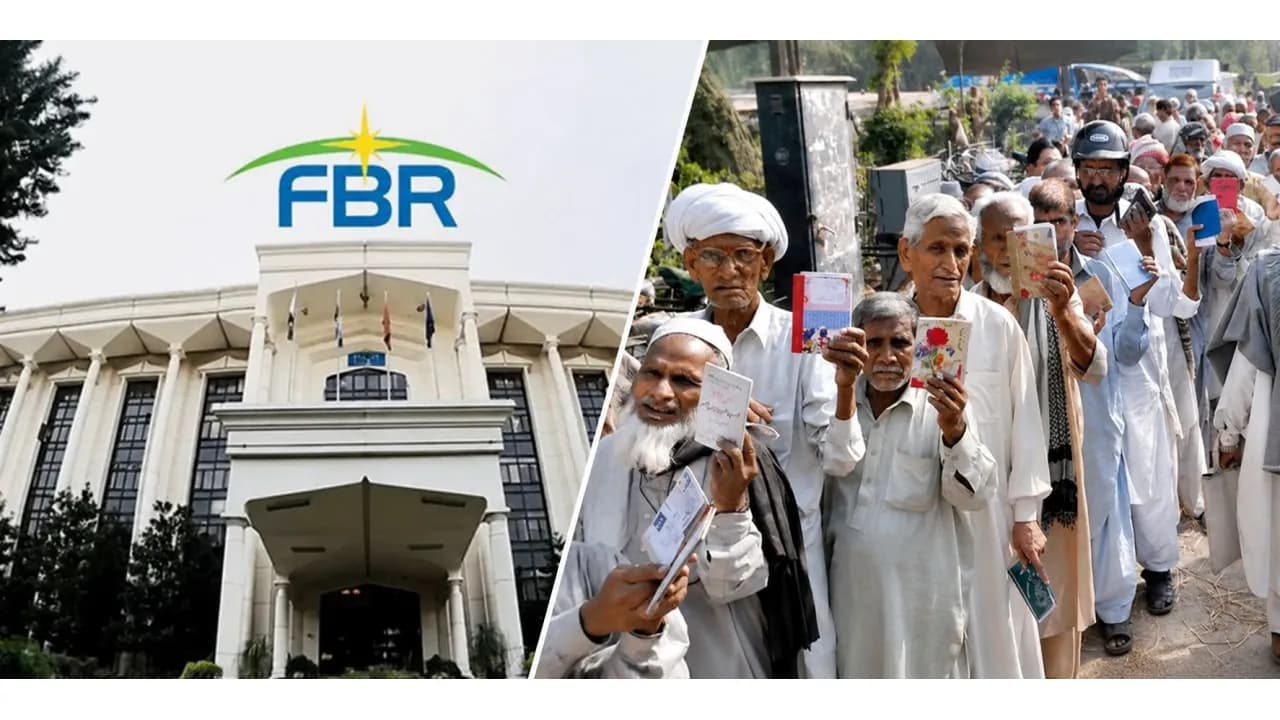
The Federal Tax Ombudsman has called on the Federal Board of Revenue (FBR) to review a disputed tax calculation affecting people who earn returns from Behbood Savings Certificates and Pensioners’ Benefit Accounts. Despite these directions, the tax authority has not yet taken action, according to Waheed Shahzad Butt, Chairman of the LTBA Public Interest Litigation Committee.
Mr. Butt stated that the FBR has neither contacted the complainant nor corrected the calculation. He criticized the authority for failing to address the issue, which involves tax relief intended for pensioners and savings certificate holders.
Under the Income Tax Ordinance, 2001, the tax on profits from these specific savings schemes is restricted to 5 percent. However, the complainant reported that the FBR’s Iris tax filing system applies this reduced rate via code 9309, but subsequently adds a 10 percent surcharge under Section 4AB. This surcharge is calculated using the full tax amount before the reduction is applied, which the complainant says effectively removes part of the tax relief approved by Parliament.
The complainant contacted the FBR Chairman, Member (Policy), and Director General (IT & DT) on October 24, 2026, to provide details on the correct calculation. He received no response to that communication, nor did he receive a decision on his request for an extension before the October 31 deadline. On November 1, the FBR system marked his tax status as “In-Active” and demanded a Rs. 25,000 surcharge to restore his status on the Active Taxpayers’ List.
During the proceedings, the Federal Tax Ombudsman noted that the FBR’s Policy Wing, Operations Wing, and IT directorate did not attend the hearing or submit comments. Only PRAL, the company responsible for the tax system, appeared and requested the complainant provide his National Tax Number (NTN), supporting documents, and a draft tax return.
The Federal Tax Ombudsman ruled that the FBR’s failure to respond to the October 24 complaint within a reasonable time constituted maladministration under the Federal Tax Ombudsman Ordinance, 2000. The ombudsman recommended that the FBR direct its Member (Policy), Director General (IT & DT), and the relevant PRAL General Manager to review the case immediately. The FBR was asked to investigate if a problem in the Iris system’s calculation was causing the incorrect surcharge. If a discrepancy is found, the FBR was told to correct it within 10 days, involve the complainant if necessary, and address his concerns.
Butt noted that pensioners and Behbood certificate holders are among the most vulnerable taxpayers. He added that people who follow tax rules should not be made to pay taxes they do not legally owe or lose their active taxpayer status because of an error in the FBR’s own system.