Beijing stated that shifts in Taiwan's political landscape will not alter the trajectory of cross-strait relations or stop the trend towards reunification. The statement was issued in response to the island's local elections held on Saturday.
Zhang Han, spokeswoman for mainland China's Taiwan Affairs Office, said in a statement on Sunday, "Seeking peace, development, exchange and cooperation represents the mainstream public opinion on the island." She added, "Regardless of how the political landscape within the island may shift, it cannot alter the direction and trend of cross-strait relations moving forward, nor can it stop the historical trend that the motherland must and will be reunified."
Zhang said people on both sides of the Taiwan Strait share a common aspiration to strengthen cross-strait exchanges and cooperation and to safeguard peace and stability across the strait. She stated that Beijing would continue to deepen cross-strait exchanges and cooperation, resolutely combat "Taiwan independence" separatist forces, and oppose interference by external forces.
The "nine-in-one" elections on Saturday were viewed as a midterm test for Taiwanese leader William Lai Ching-te, who has been in office since May 2024. The elections covered nine categories of local office from city mayor and county magistrate down to village chief. The contests focused largely on local issues, grass-roots ties, and track records in municipal governance, with cross-strait relations being less of a concern than in the island's general elections.
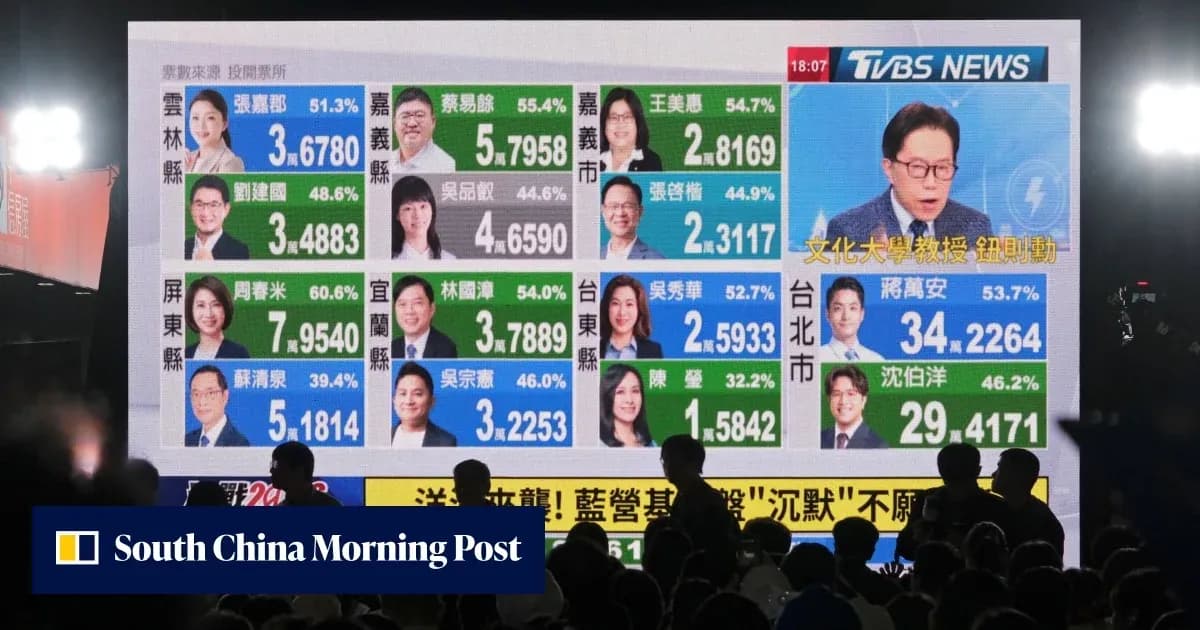
The Democratic Progressive Party (DPP) gained five seats to have a total of 10, flipping the KMT-held seats of Taichung city, Hsinchu county, Yilan, Changhua, Chiayi city, and Yunlin. The Kuomintang (KMT) lost four city and county seats from its pre-election tally, winning just 11. The KMT gained the two strongholds of Taipei and New Taipei City, but lost the key swing municipality of Taichung. Penghu flipped from the DPP to the KMT. The remaining contest in Hsinchu city was won by an incumbent independent candidate.
The results dealt a setback to KMT chairwoman Cheng Li-wun. Speaking about the KMT's losses on Saturday night, Cheng said "local integration and internal party unity will always be an unavoidable required course for the Kuomintang". The results were also a blow to the prospects for Taichung mayor Lu Shiow-yen, who is widely seen as a leading contender for the KMT's nomination in 2028.
Beijing watched the race in Taipei where incumbent mayor Chiang Wan-an of the KMT won re-election against DPP lawmaker Puma Shen Pao-yang. Chiang defeated Shen by 8.03 percentage points with a voter turnout of 72.14 per cent. Beijing designated Shen a "diehard Taiwan independence separatist" in October 2024 for leading the civil defence group Kuma Academy, banning him and his family from entering the mainland and engaging in commercial ties there.
In October, Beijing reiterated that Shen, as a separatist force, "has no qualifications whatsoever to speak glibly of cross-strait exchanges and cooperation". Beijing also barred VWAY, a company linked to Shen's father, from all mainland commercial activities. Beijing views Taiwan as part of China to be reunited by force if necessary. Most countries, including the United States, do not recognise Taiwan as an independent state, but Washington is opposed to any attempt to take the self-governed island by force and is committed to supplying it with weapons.