Key Takeaways
- US President Donald Trump welcomed Chinese President Xi Jinping to the White House for a state summit.
- The visit is expected to focus on extending a trade truce and examining threats posed by artificial intelligence.
- Both leaders aim to maintain stable ties despite underlying rivalry.
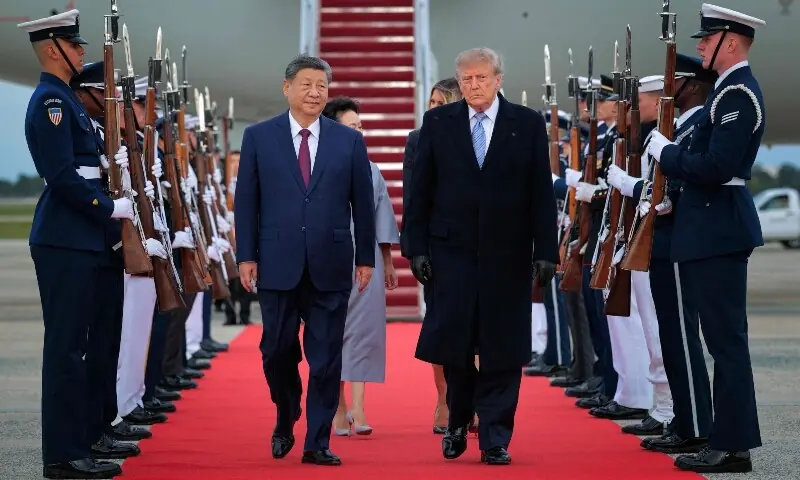
US President Donald Trump welcomed Chinese President Xi Jinping to the White House on Thursday for a state summit, marking the year’s second meeting between the leaders of the world’s two largest economies.
The visit, Xi’s first to Washington in over a decade, is expected to be heavy on symbolism, with both leaders keen to showcase stable ties despite a deep underlying rivalry.
Trump greeted Xi on arrival on Wednesday evening, the first time a US president has welcomed a foreign leader at Joint Base Andrews in 11 years, according to C-SPAN, which tracks presidential events.
In a statement on arrival, carried by China’s Xinhua news agency, Xi voiced hope for a more stable relationship with the United States, saying Beijing and Washington should be “partners, not rivals” and that the “historical logic of peaceful coexistence” between the two countries had not changed.
For Trump, the visit is as much a matter of national prestige as an opportunity for high-stakes diplomacy, with the aim of reciprocating the grand welcome he received in China in May.
Analysts say tangible outcomes are likely to be limited to an extension of a trade truce expiring in November and an agreement to examine threats posed by artificial intelligence.
US Treasury Secretary Scott Bessent told Fox News on Wednesday after talks with Chinese Vice Premier He Lifeng that they had agreed to extend until January 10 an agreement that paused a trade war that saw mutual tariffs top 100 per cent.
People familiar with the plans say the talks could also yield deals to lower some tariffs, combat drug trafficking, and expand military-to-military dialogue, while Trump is expected to seek the release of Americans and others detained in China.
Former Deputy Secretary of State Kurt Campbell said the summit was less about substantive negotiations than a chance for two forceful leaders to project strength. “This is really the historical reincarnation of what we often referred to in antiquity as single combat — really powerful guys, each representing their civilisations, kind of measuring and going toe to toe,” said Campbell.