Key Takeaways
- Pakistan’s middle class is facing increasing financial strain as essential services become more expensive.
- Average monthly household income barely exceeds consumption expenditure, leaving little room for savings.
- The government’s approach of personal responsibility is exacerbating the middle class’s economic challenges.
Pakistan’s middle class is grappling with the daily reality of rising costs and unreliable services, according to a recent report by the Pakistan Bureau of Statistics. The report highlights that average monthly household income from 2024-25 was Rs82,179, while consumption expenditure averaged Rs79,150, leaving a margin of only Rs3,000.
This narrow margin underscores the fragility of middle-class life, as even minor expenses can quickly turn a stable household into a borrowing one. A medical emergency, a period of unemployment, or a rise in school fees can destabilize families that have barely managed to keep up with their basic needs.

The government’s strategy of urging citizens to become more economical and resilient in the face of economic challenges is increasingly seen as a political failure. When electricity becomes too expensive, households are advised to consume less, and when public hospitals fail, people are directed to private doctors. This approach shifts what should be public responsibilities into private calculations.
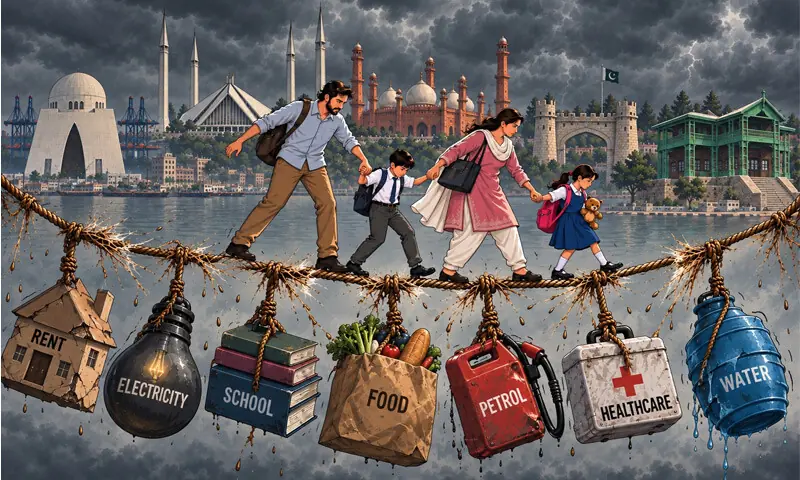
The squeeze on the middle class is not just about inflation but also about the growing cost of securing the basics of everyday life. As essential services like water, education, healthcare, and transport become increasingly expensive or unreliable, the middle class is forced to make difficult choices. These choices often involve sacrificing long-term stability for short-term survival.
The quiet desperation of the middle class is evident in the gradual narrowing of their lives. Savings do not accumulate, treatments are postponed, and the prospect of renting a house or sending children to school becomes a financial calculation. For many, the idea of leaving the country is no longer a choice but an economic necessity.
This quietness is politically disturbing because it suggests that the middle class is being systematically squeezed. The cost of living is often discussed as an unavoidable weather event, but it is, in fact, a result of government decisions and negotiations with institutions. Tariffs, taxes, and public expenditure are not beyond anyone’s control; they are decisions made by governments and ultimately paid for by citizens.
The Pakistan Bureau of Statistics’ data reveals the stark reality of the middle class’s financial situation. The margin between income and expenditure is so thin that any unexpected expense can quickly turn a stable household into a borrowing one. This fragility is a clear indication of the economic pressures faced by the middle class, who are expected to bear the brunt of government failures.
The government’s approach of personal responsibility is exacerbating the middle class’s economic challenges. Instead of addressing the root causes of these issues, the government is pushing the burden onto individuals, who are increasingly struggling to meet their basic needs. This approach is not only failing to alleviate the middle class’s economic pressures but is also creating a sense of resignation and despair among those who are trying to maintain their standard of living.