Key Takeaways
- Farmers and mills continue annual negotiations over sugarcane prices.
- Public policy focuses on short-term price fixes rather than long-term productivity improvements.
- Agricultural extension services need to be strengthened for sustainable growth.
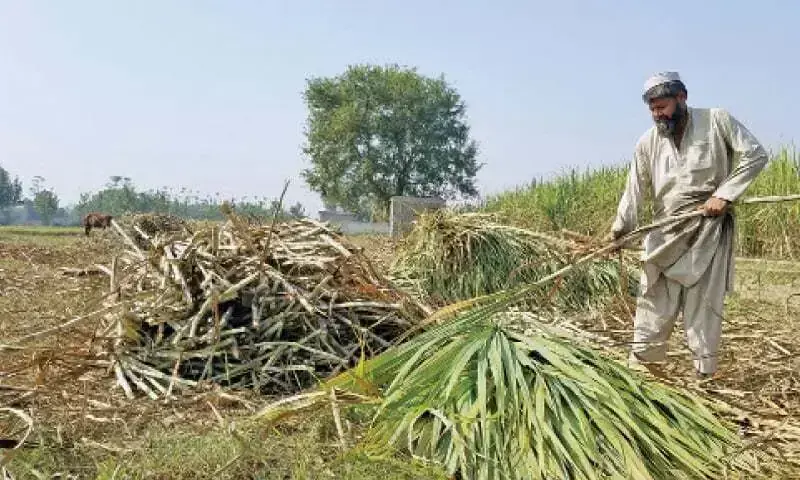
Every year, as the sugarcane crushing season approaches in Pakistan, farmers and sugar mills engage in a familiar debate over pricing. Farmers demand higher prices to offset rising production costs, while mills argue that increased procurement prices make sugar commercially unviable. Governments intervene to broker settlements, but the underlying issue remains unresolved: why does Pakistan continue to treat sugarcane as a pricing problem rather than a productivity challenge?
According to the Pakistan Economic Survey 2025-26, agriculture contributes 23.4 per cent to Pakistan’s GDP and employs about 33 per cent of the national workforce. However, the sugarcane crop only accounts for 0.8 per cent of this GDP. Despite one favourable season where production rose by 6.2 per cent to 89.45 million tonnes, the sector faces deep-rooted challenges such as stagnant-to-declining farm productivity in many regions, rising cultivation costs, deteriorating water availability, climate variability, labour shortages and inconsistent technology adoption.
Public policy has traditionally focused on annual price notifications rather than addressing these structural issues. Provincial governments devote considerable administrative effort to fixing support prices and resolving disputes between millers and growers’ bodies. While fair prices are essential for protecting farmers' economies, they have gradually become the dominant measure of policy success. Productivity, innovation, and resource efficiency receive far less attention.
The real measure of success is whether farmers can produce more from the same investments. Land is finite, water is becoming increasingly scarce, and climate risks such as high temperatures and untimely rains are intensifying. The next generation of agricultural growth must come from producing more output with fewer resources. The first priority should be rebuilding agricultural extension services.
Pakistan has invested heavily in agricultural research over several decades. Research institutions and universities have developed improved crop varieties like CPF-246, HSF-240, and YTFG-236, better nutrient management practices, and more sustainable pest-control strategies. However, scientific knowledge often remains confined to experimental stations instead of reaching farmers' fields.
The country’s extension system has gradually weakened, leaving many farmers dependent on inherited practices or commercial input dealers for technical advice. Modern agriculture requires something different: research-based professional extension services that combine field demonstrations with digital advisory systems, satellite imagery, weather-based recommendations, and artificial intelligence (AI) to deliver timely information.
In conclusion, while annual price negotiations are necessary, they should not overshadow the need for productivity improvements. Strengthening agricultural extension services is crucial for ensuring sustainable growth in Pakistan’s sugarcane sector.