Key Takeaways
- The KSE-100 Index dropped by nearly 2,300 points in early trading.
- Geopolitical tensions between the US and Iran caused widespread selling across key sectors.
- International markets also experienced declines as oil prices surged.
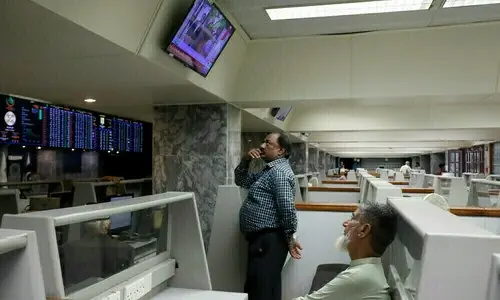
Negative sentiments dominated Pakistan's stock market on Monday morning amid escalating geopolitical tensions between the United States and Iran. The benchmark KSE-100 Index plummeted by nearly 2,300 points in its opening minutes of trading, marking a significant downturn for investors.
At 9:43am, the index stood at 179,972.52, down by 2,269.25 points or 1.25%. This decline was observed across various sectors, including automobile assemblers, cement companies, commercial banks, oil and gas exploration firms, OMCs (Oil Marketing Companies), and power generation entities.
Key index-heavy stocks such as HUBCO, MARI, OGDC, PSO, SSGC, SNGPL, MCB, MEBL, NBP, and UBL all traded in the red. The previous week saw a similar trend, with the KSE-100 Index declining by 1.7% on a week-on-week basis, losing 3,130.43 points to close at 182,241.77.
Internationally, share markets experienced a downturn as fighting intensified in the Gulf region. Iran's claim to have closed the Strait of Hormuz sent oil prices soaring and rekindled inflation risks globally. Brent crude climbed by 4.1% to reach $79.11 per barrel, while U.S. crude added 4.1% to $74.37 a barrel.
The dollar strengthened as bond yields rose with investors narrowing the odds of an interest rate hike from the Federal Reserve. This development came just a day before Chair Kevin Warsh was due to face Congress for his first appearance in his new role. Inflation figures for June could show some cooling, but this might be reversed given the recent rise in oil prices.
Equity investors are hoping that the earnings season will prove as positive as forecasted, with major banks set to kick off from Tuesday. Other notable companies like Netflix and General Electric are also on the agenda. S&P 500 futures eased by 0.4%, while Nasdaq futures lost 0.9%. In Europe, EUROSTOXX 50 futures and DAX futures both fell by 0.6%, while FTSE futures dipped by 0.1%.
Japan’s Nikkei fell by 1.6%, having shed 1.7% the previous week, while MSCI's broadest index of Asia-Pacific shares outside Japan dropped by 0.9%. South Korea’s market, which had been red-hot, lost 5.4% and will be closely watched, given its significant decline last week due to leveraged bets on semiconductor shares.
The global market has emerged as a key barometer for chip-sector sentiment, and further losses could ripple more broadly.