Key Takeaways
- Sindh Assembly approved the Sindh Local Government (LG) Act 2026 (Amendment) Bill.
- The bill allows outgoing mayors and chairmen to continue as administrators after their terms expire.
- It introduces new institutions and reconciliation forums to manage local disputes.
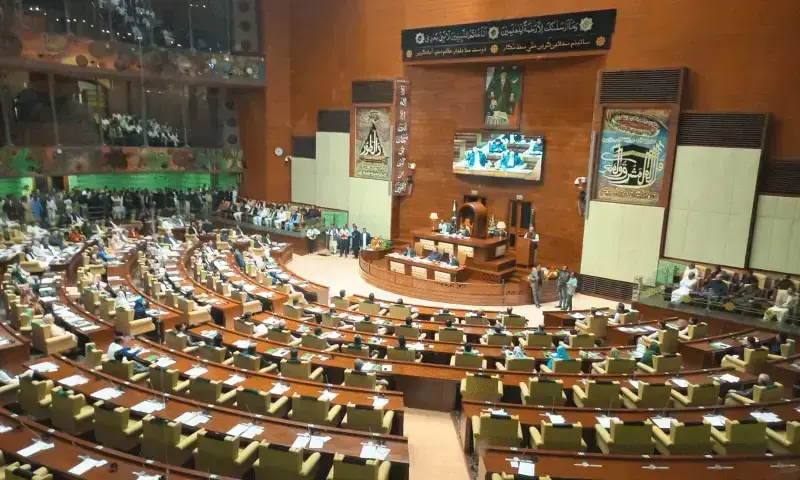
The Sindh Assembly has passed the Sindh Local Government (LG) Act 2026 (Amendment) Bill, despite loud protests from opposition parties. Law Minister Ziaul Hassan Lanjar introduced the bill after presenting the report of the special committee that examined the proposed amendments.
During the debate, opposition lawmakers gathered in the aisles and chanted slogans against the proposed changes to the local government laws, disrupting proceedings for several minutes. All opposition parties had previously jointly rejected the proposed amendments, calling the draft law ‘unconstitutional’ and an attempt to weaken elected local bodies.
The bill allows councils to establish institutions independently or through public-private partnerships. It also mandates that the government request the Election Commission of Pakistan 120 days before the expiry of a council’s term to hold fresh elections within that period.
Crucially, the bill provides that on expiry of a council’s term, the outgoing mayor or chairman would continue to exercise powers and perform functions of the council as ‘Administrator’ until the newly elected head assumes office. This provision was a key point of contention during the debate.
The bill also empowers the government to entrust the duties of a deputy mayor or vice-chairman to another member if the officeholder is absent from Pakistan or unable to perform functions. This ensures continuity in local governance during critical periods.
Two new entries have been added to Schedule-IX. Union councils (UCs) will now be responsible for identifying solid waste management issues, building control violations, and unauthorised constructions within their jurisdiction, and sharing information with relevant authorities for action.
Additionally, the bill proposes the insertion of a new Chapter VII-A to establish ‘Reconciliation Forums’ in every union council, union committee, town committee, and municipal committee. Each forum will consist of a panel of three conciliators, nominated by the council from among residents known for integrity, sound judgement, and respected standing.
The conciliators will hold office for the term of the council and may be removed for ‘consistent partiality or malpractice’. These forums are tasked with the amicable settlement of local disputes in accordance with prescribed procedures.
The bill aims to streamline local governance and ensure smoother transitions of power, but opposition parties remain unconvinced, viewing the amendments as a threat to the autonomy of elected local bodies.