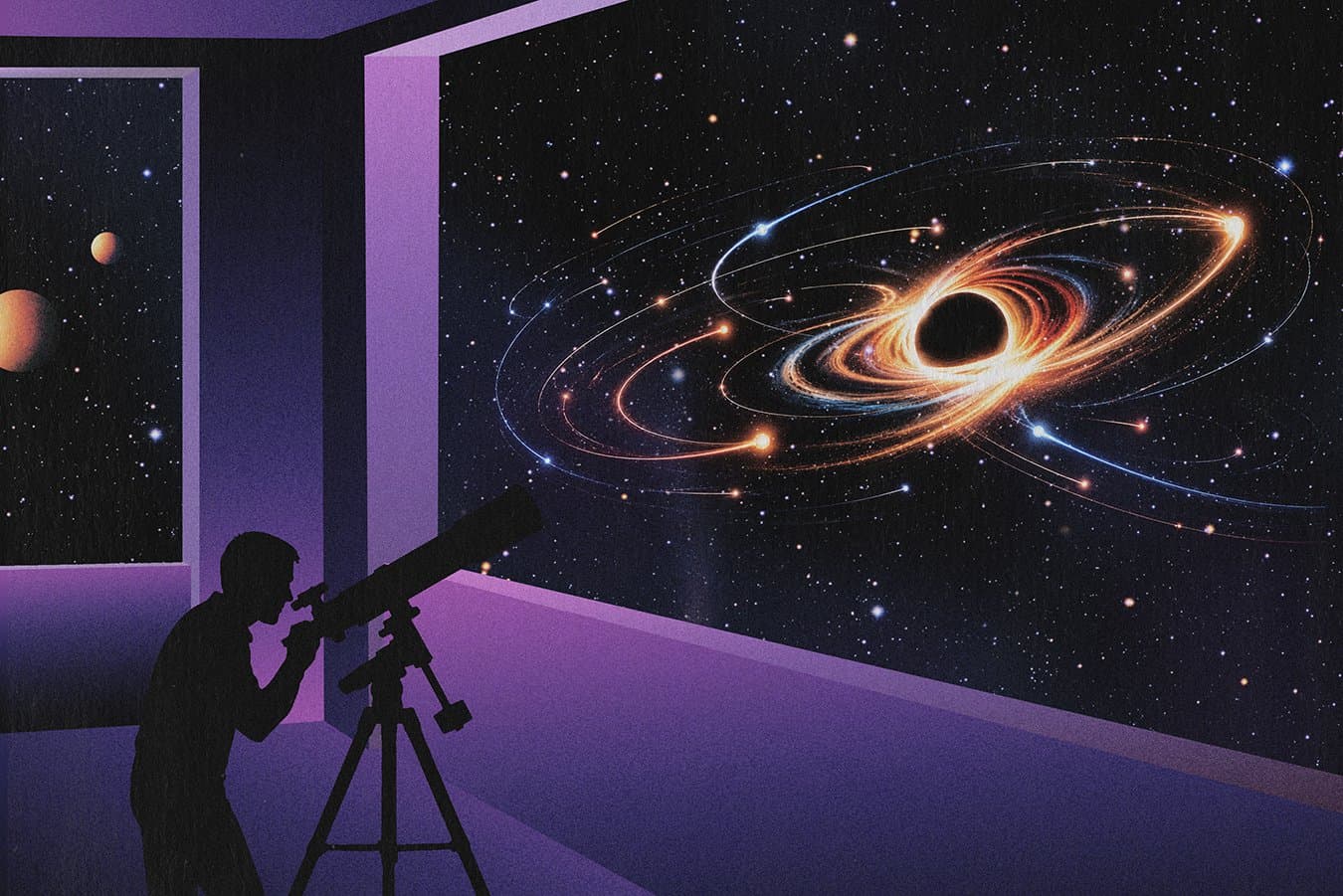
Star S301 travels at more than 8 per cent of the speed of light, making it the fastest known star in a superhighway of stars circling the Milky Way's central black hole. The stars orbiting the black hole reveal hidden properties of the black hole, test gravity, and expose what lies around it.
Earth resides in one of the Milky Way’s spiral arms, situated roughly 26,500 light years from the galaxy's centre. The central black hole, Sagittarius A*, was first discovered in 1974.
In the late 1990s, two groups, led by Reinhard Genzel at the Max Planck Institute for Extraterrestrial Physics and Andrea Ghez at the University of California, Los Angeles, used adaptive optics to spot the first stars near the galactic centre. These initial stars were observed moving at approximately 2000 kilometres per second and passing within a light month of Sagittarius A*.
Genzel’s team identified a star named S0-2 in 2002. S0-2 reached a speed of around 7650 km/s at its closest approach to Sagittarius A*, which occurred within 17 light hours.
Researchers tracked S0-2’s path using interferometry in 2018, enabling them to determine the mass of Sagittarius A. The work concerning Sagittarius A resulted in Genzel and Ghez receiving a Nobel prize in 2020.
Astronomers have identified three separate groups of stars orbiting the black hole: S stars, clockwise-disc stars, and off-disc stars. The S stars appear surprisingly young, with a lifespan shorter than the time elapsed since the dinosaur extinction.
A leading theory suggests the S stars originated from binary systems that Sagittarius A* tore apart. Xiaochen Zheng and colleagues proposed a model suggesting another massive object, such as a smaller black hole or dense star cluster, could account for the three star populations.
The team has observed a star cluster called IRS-13E, which might house a black hole with the correct mass. The Event Horizon Telescope captured an image of Sagittarius A*'s shadow in 2022.