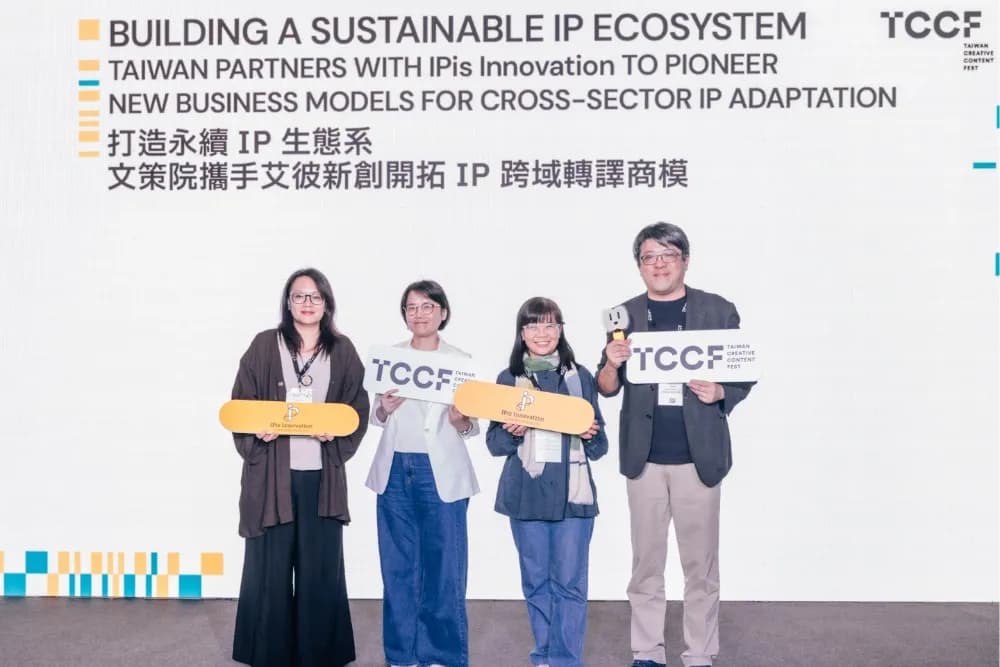
Taiwanese companies presented strategies for transforming original stories into diverse commercial products, including stage plays, series, fragrances, and travel itineraries, during a session on cross-sector intellectual property at the Taiwan Creative Content Fest (TCCF) in Taipei.
Mimi Wang, COO of the Taiwanese IP development company IPis Innovation, stated that the original intention behind developing IP is for the industry to thrive together so everyone can make money. Wang noted that their approach was partly modeled on South Korea, where IP adaptation began 30 years ago. She said policies there brought industries such as fashion and electronics to collaborate and invest in cultural products, which she identified as the origin of the Korean Wave.
Wang explained that IPis often begins with books because they offer a cheaper way to find stories with existing readers. According to Wang, a stage production can then test audience demand through ticket sales before a company moves into screen adaptations and related products. She cited the company’s stage play “Marital Lost Love,” based on a book by psychiatrist Deng Hui-wen, which sold out over three runs. Following those runs, IPis extended the project with a podcast and two fragrances.
Wang also highlighted the series project “Do You Still Love Me?” which was developed from a novel. The project won five awards at TCCF Pitching in 2025, more than any other project that year, including the udnFunLife IP Potential Award. Wang attributed the success of the pitch to its clear, engaging story and its demonstration of how to reach audiences and create business opportunities. Plans for the project include brand partnerships, product placement, a revival of the reality show “Love Battle,” and a feature film titled “99 Days to Countdown.” Wang noted the film’s honeymoon trip could also become a travel itinerary built with tourism partners.
Wang stated that the IP development plan has three main pillars: emotional resonance, ESG [environmental, social and governance] and Taiwanese values. To represent Taiwanese identity, she pointed to “Siwei Street No. 1” by Yang Shuang-zi. IPis plans a stage version of the novel alongside food events using a Japanese colonial-era Taiwanese cookbook featured in the story. Other proposed ideas include a Taiwanese banquet, an exhibition, scent-based products, and character booklets. Wang reported that Japanese partners have already shown interest in licensing or other forms of collaboration.
Erica Wang, CEO of the Taiwan Creative Content Agency (TAICCA), which organizes TCCF, said a successful investment needs three key conditions: profitability, stability and growth. She added that in the IP field, the goal is to find a formula for profitability through a “one source, multiple uses” approach.
Owen Lee, chair of udnFunLife, the events and ticketing arm of Taiwan’s United Daily News Group, said his company focuses on cross-industry uses of IP, such as theater, exhibitions, experiences, and merchandise, while leaving the original creative work to creators. Lee stated that his company invests in projects and helps determine how to bring them to audiences and sell them.
For investors, Lee said extending an IP depends partly on whether the rights are available. His company seeks priority rights to develop extensions and checks whether adaptation and sequel rights are clear, and whether permissions for performers, characters, and music would need to be renegotiated for each new use. Lee also evaluates an IP’s “spillover value,” specifically whether audiences recognize it and whether the premise adapts easily to other formats. He noted that a clear, accessible title can reduce the marketing needed to explain a project to new audiences, while cost and timing also shape which extension fits.
Lee cited an exhibition built around the Taiwanese horror film “The Rope Curse 3” before its release, which used franchise material to build interest. He also mentioned a mobile VR experience being planned around “The Rope Curse 4.” Lee expressed that he sees strong potential in Taiwan’s live-action film, TV, and theater IP, while noting that character-based properties and animation still have room to grow.
Mimi Wang concluded by stating that the starting point remains the audience, suggesting that creators should ask what viewers want to see and how a personal story can speak to a wider public.