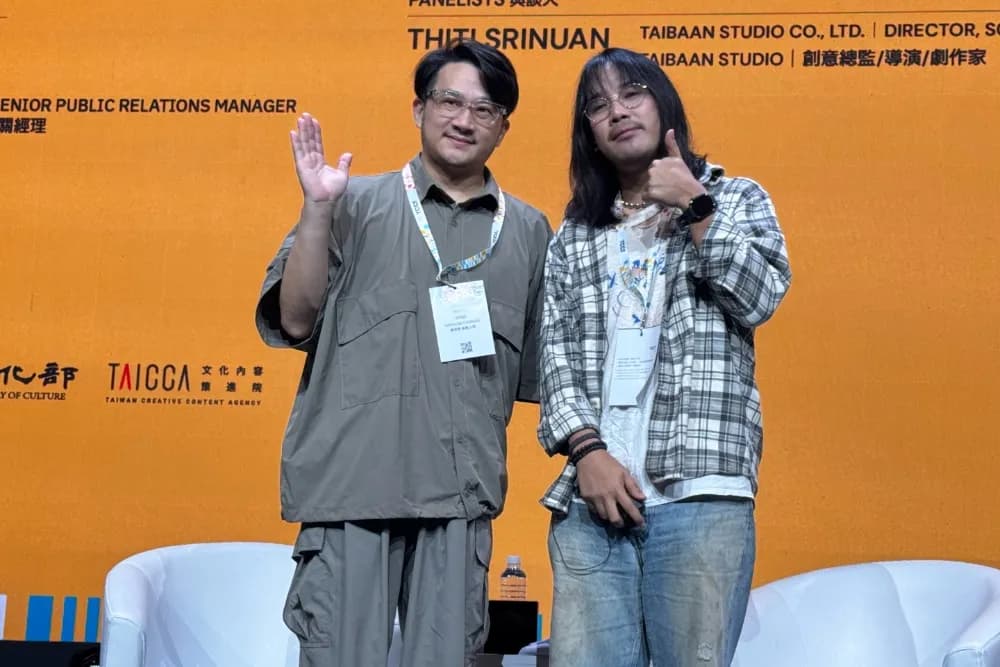
Thiti “Tongte” Srinuan, the director of the Thai blockbuster “The Undertaker,” shared a photo during the Taiwan Creative Content Fest in Taipei showing himself defecating on camera for real. The footage dates back to his time as a supporting actor for Taibaan Studio. Srinuan explained that he played a "crazy person" character who "relieves himself wherever he likes."
The production opted for real action over using a prop. Srinuan recalled that "Forty or 50 people were sitting there watching me, and I felt like I couldn’t go," he said. Mr. Knee, the senior public relations manager at Vieshow Cinemas and founding chair of the Taiwan Film Critics Society, moderated the session and noted that the photo was a surprise to the organizers, who had only seen it that morning.
Srinuan stated that the incident demonstrated the studio's commitment to realism, which he believes makes the Taibaan universe flexible. He noted that because every character feels like a real resident of the same village, any character can be pulled out to lead a film, whether the studio wants a romance or a ghost story.
Srinuan, who wrote and directed “The Undertaker” and its sequel for Taibaan Studio, was the sole panelist at the forum discussing how user-generated content is becoming a route to theatrical features. He focused heavily on the financial aspects of the studio. Before “The Undertaker” grossed more than THB700 million ($20.8 million) in Thailand, much of the Taibaan universe was funded by revenue from online music videos. The 2023 film, the sixth in the universe, became the highest-grossing Thai film in nine years.
The franchise is rooted in the culture and language of Thailand’s northeastern Isan region. Srinuan entered the industry as an extra and supporting player. Because the crew was a small group from rural Thailand with little formal training, he volunteered to write scripts and assist in directing, working on five films in those roles. He noted those films played almost entirely to Isan audiences. After a music video he made went viral, he was convinced a film from the region could cross over. When no one else would take his script, he directed it himself.
Budgets have remained lean. The first Taibaan film raised THB2 million ($59,000), or THB4 million ($119,000) including marketing, and grossed THB35 million ($1 million). This was achieved in a market where a typical Thai feature costs THB30 million ($891,000) or more. “The Undertaker” was budgeted at THB10 million ($297,000), though Srinuan said only THB8 million ($238,000) was spent, with the remaining THB2 million added to make it a round number.
Raising money for a follow-up was more difficult. “If we were still nobodies with no name, they couldn’t invest in us,” Srinuan said. The team instead built an online following. “Believe it or not, after the first film, the second, third and fourth films were funded by what we built online,” he said. “We earned money from music videos. The views kept running and running until we could take that money and make films.”
Srinuan used music videos to fill the months between film shoots. His videos have now passed 4 billion views combined. He asked clients for a share of view revenue rather than flat fees, which forced him to learn marketing because a flopped video earned him nothing. He has carried these terms into features, asking to be paid from ticket sales instead of a fixed fee.
Music videos also influenced his writing style. He builds features out of segments of four to five minutes, the length of a music video, and lays them end to end until they reach two hours. He said this suits audiences raised on short-form and vertical content. “The downside is people comment that the film swings and the emotions don’t connect. You’re laughing, then you’re made to cry, then you’re laughing again,” he said. “But to me, life is like that. You laugh sometimes, you cry sometimes. So I like it this way.”
Srinuan noted that comments matter more to the studio than likes or shares. If viewers fixate on an unexpected character in the comments, the marketing shifts toward that character. After the first Taibaan film, Srinuan borrowed a habit from Marvel by announcing a universe before scripts existed to keep himself working. The title of “The Undertaker” came first; he chose the profession because he figured no one sees more ghosts. He drew on his own childhood in the countryside, where he was paid to be ordained as a novice monk for funerals and watched undertakers at close range.
The film turned from horror into drama, though it was still marketed as a ghost film in Thailand because that genre sells. When the first film played in Taiwan two to three years ago, it did not catch on. “I’d like to ask the market now: does Taiwan still want blood-splattered Thai films?” Srinuan said. He suggested Taiwanese viewers expected gory horror, while his ghosts are played for laughs.
Srinuan stated that Isan is Thailand’s most populous region, but its local beliefs did not travel to the other three regions. For “The Undertaker,” he studied Charlie Chaplin and used visual storytelling over dialogue. He found that while the comedy landed overseas, the local culture often did not, calling reaching a global audience a challenge he is still working on.
After finishing the first “Undertaker,” Srinuan took marketing classes. The film opened only in Isan to core fans first, and word of mouth pulled it into cinemas across the rest of the country, a strategy he likened to “the forest surrounding the city.”
Srinuan argued that ideas count for more than budgets. “If you don’t create work, miracles won’t happen,” he said. He noted that the success of “The Undertaker” has drawn Thai YouTubers into features. He warned that while creators may think their followers will watch, the reality is different. “They think, ‘I have 1 million followers on YouTube. I make a film, so all 1 million people who follow me have to watch it, right?’” “In reality, the first person goes in and says they didn’t like it, and the other 999,999 start deciding whether to watch or not. Then the second person goes in and says it’s not OK, and 900,000 people are gone.”