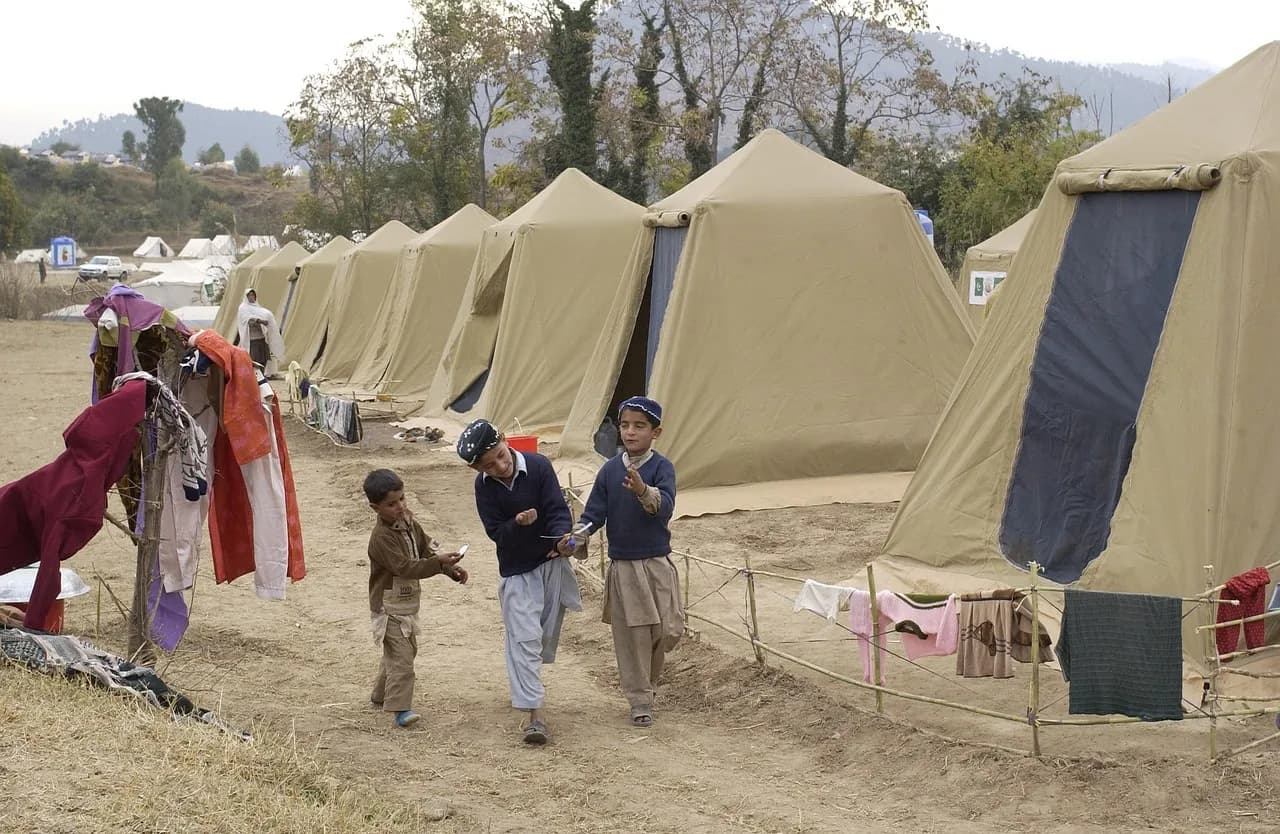
The International Monetary Fund (IMF) has assessed that refugee inflows have had a limited economic impact on Pakistan, citing relatively small shocks to labour supply and government spending. This finding comes despite the country hosting one of the largest refugee populations in the Middle East, North Africa, Afghanistan and Pakistan (MENAP) region.
In a 2026 departmental paper titled The Macroeconomic Impact of Refugee Flows in the Middle East and Central Asia, the IMF stated that its modelling of refugee arrivals, which have been largely from Afghanistan since 2022, showed a significantly smaller impact on Pakistan’s economy compared with Jordan, Lebanon and Iran. The Fund attributed this limited impact to relatively small labour market and refugee-related spending shocks in Pakistan.
The paper noted that estimates indicate the potential recurrent costs of hosting refugees are often substantial. For the countries hosting the largest refugee populations, the total annual cost per refugee for 2020–21 came to some USD 1,102 in Lebanon and USD 720 in Jordan on average. In Iran, the cost is slightly lower but still significant at USD 572, whereas it is about USD 181 in Pakistan.
The IMF stated that these substantial cross-country differences originate from the differing poverty lines/gaps and costs of providing public services. In Lebanon and Jordan, the costs are above 1 percent of GDP, whereas it is below 1 percent of GDP for the other host countries, where the incidence of refugees over total population has been much lower.
The assessment is based on the Fund’s Flexible System of Global Models (FSGM), which examined the economic consequences of refugee inflows in selected host countries by comparing outcomes against pre-inflow economic projections. The paper noted that refugee inflows generally affect host economies through three channels: additional labour supply, increased public spending on essential services, and pressure on public infrastructure.
According to the IMF, additional labour supply can increase overall economic activity, but may also raise unemployment, particularly where domestic labour markets are unable to absorb new workers. The impact on per capita income can also be negative because of lower average labour productivity among refugees. The Fund said refugee-related expenditure on food, shelter, healthcare and education could increase aggregate demand while placing pressure on government finances, particularly where international assistance does not adequately cover hosting costs.
The IMF’s estimates of potential recurrent costs, covering subsistence requirements, healthcare and education, also showed that the financial burden varies considerably across host countries depending on the size of refugee populations relative to their economies. The IMF’s estimates for 2020-21 included Pakistan alongside Jordan, Lebanon and Iran. The assessment covered potential recurrent expenditure and donor assistance, including support for Palestine refugees under the UNRWA mandate.
The report further observed that international financial assistance provided only partial coverage of refugee-hosting costs across the region, with a substantial proportion of assistance directed towards humanitarian relief rather than longer-term development requirements. It argued that prolonged displacement situations require greater investment in public infrastructure, particularly healthcare and education facilities, to prevent pressure on services from undermining the quality of provision for host communities.
The IMF also identified restrictive policies on employment, property ownership and access to essential services as constraints on refugees’ economic self-reliance and their potential contribution to host economies. It maintained that facilitating refugees’ participation in labour markets could reduce dependence on public assistance and improve medium-term fiscal and external balances, provided domestic economies had sufficient capacity to absorb additional workers.
The report cautioned that its findings were subject to data limitations, particularly gaps in refugee population statistics and financial information on hosting arrangements. The analysis covers the period through the end of 2023, while the country-specific modelling for Pakistan examines refugee inflows beginning in 2022. The Fund stressed that its findings should therefore be interpreted within the scope of the periods and assumptions used in the assessment.