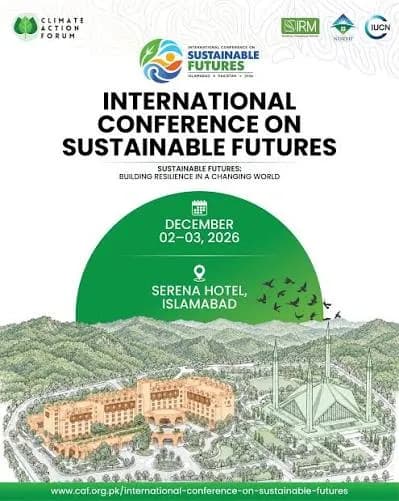
Organisers are stepping up arrangements for the International Conference on Sustainable Futures 2026, which is scheduled to take place in Islamabad on December 2–3. The Institute of Rural Management (IRM) is hosting the two-day event in collaboration with the Climate Action Forum (CAF), International Union for Conservation of Nature (IUCN), National Disaster Risk Management Fund (NDRMF), and United Nations Children’s Emergency Fund (UNICEF).
The conference will be held under the theme “Building Resilience in a Changing World.” An IRM spokesperson told APP that preparations have entered their final stages. She stated that teams have been constituted and regular meetings are being held to review progress and assess on-ground arrangements.
The spokesperson noted that these meetings are intended to incorporate consultations and constructive suggestions while reviewing key arrangements. These include the conference brochure, publicity and advertising strategy, programme schedule, speakers, and administrative and operational matters. She stated that all arrangements are being made to ensure the conference is organised in a transparent, fair and competitive manner.
The conference is expected to bring together a wide range of participants, including policymakers, international experts, development partners, researchers, civil society representatives, private-sector stakeholders, youth leaders, and innovators. The goal is to discuss solutions to pressing climate and development challenges while providing a platform for knowledge exchange, partnership-building, and exploring practical approaches to emerging challenges.
Scheduled to follow COP31, the conference aims to link global climate commitments with national priorities and translate international ambitions into practical action. The event will feature six thematic areas, including climate-resilient economies, green growth and sustainable development; disaster risk management, nature-based solutions, resilience financing readiness and climate-resilient communities; and clean energy transition and sustainable infrastructure.
Other key areas to be covered include youth leadership, technology and development initiatives, food security, water, sanitation and hygiene (WASH), ecosystems, the Water-Energy-Food (WEF) Nexus, women’s empowerment, and resilient rural livelihoods. The concluding discussions will focus on the way forward, with thought leaders sharing success stories, evidence-based insights, and future perspectives to advance sustainable and inclusive development. The conference is also expected to strengthen dialogue and collaboration among diverse stakeholders to help build a more resilient and sustainable future.
The spokesperson added that the conference brochure and other relevant information are available on the official website.