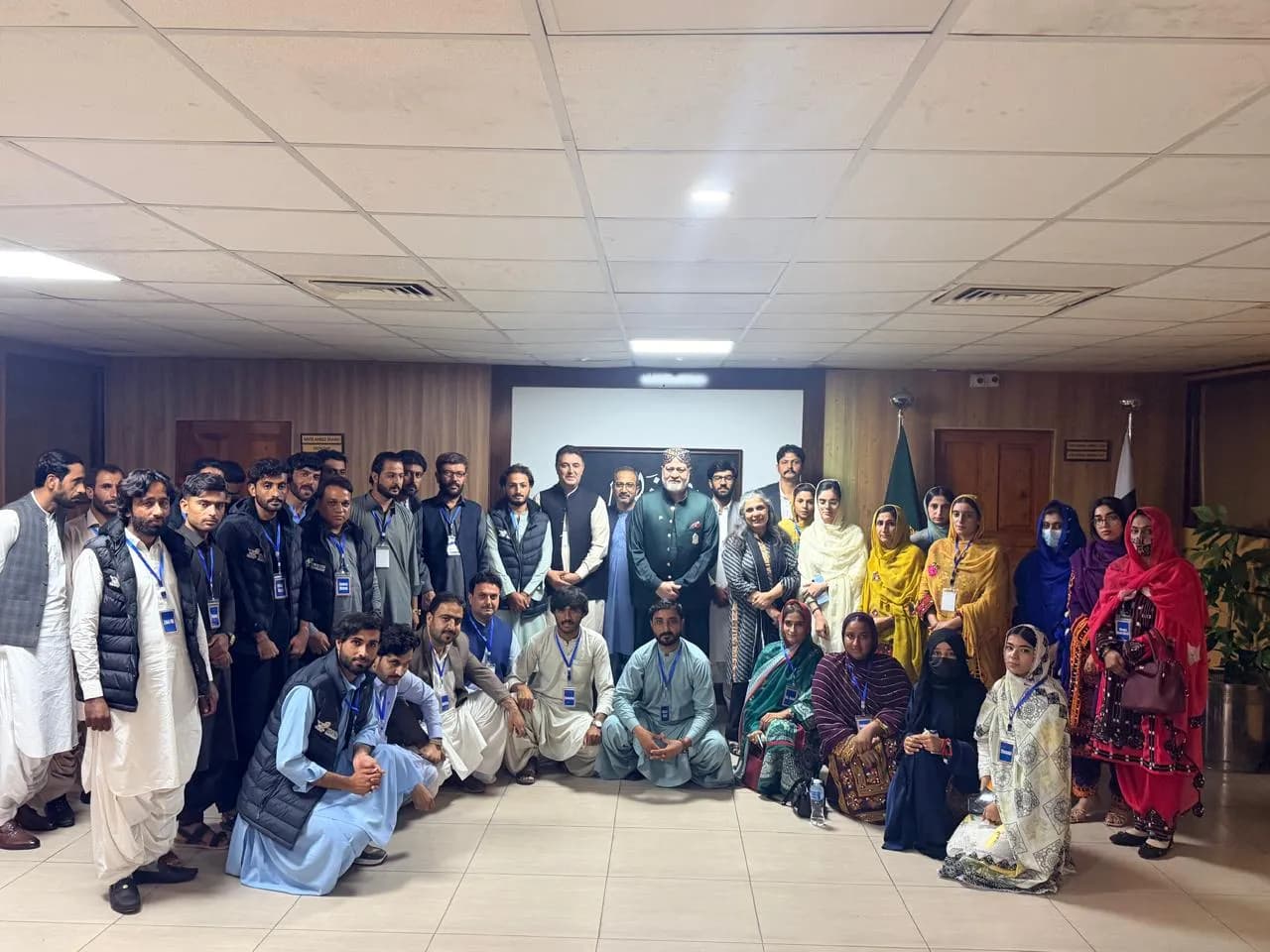
Federal Minister for Poverty Alleviation and Social Safety Syed Imran Ahmad Shah reaffirmed the government's commitment to poverty reduction and economic empowerment for vulnerable communities in Balochistan. Speaking during a meeting in Islamabad on November 12, Shah stressed that young people must be engaged as active partners in the province's development.
The meeting was held with a delegation of young people led by the Balochistan Rural Support Programme (BRSP). The group met with the minister to discuss social protection initiatives, poverty alleviation measures, and opportunities for disadvantaged communities. The discussion was held under the vision of “A Prosperous Balochistan, A Strong Pakistan,” focusing on institutional cooperation and equal access to economic opportunities.
Shah outlined several initiatives managed by the Ministry’s attached departments and partner institutions. He stated that Pakistan Bait-ul-Mal (PBM) has established four Sweet Homes in Quetta, Turbat, Zhob, and Kharan to support orphaned children. Additionally, 22 Women Empowerment Centres are providing vocational training to 6,976 women, while 14 Schools for Rehabilitation of Child Labour are offering education to 1,710 children. Shah reported that PBM spent Rs5.10 billion in Balochistan over the past decade, which included Rs2.10 billion recently, and that 4,862 individuals received financial assistance during the current government's tenure.
Regarding the Pakistan Poverty Alleviation Fund (PPAF), Shah said initiatives in underdeveloped areas are improving access to vocational training, clean drinking water, water filtration facilities, solar energy, and community infrastructure. He noted that 18 projects across 22 districts were implemented during the current government's tenure, benefiting approximately five million people, 49 per cent of whom were women.
The minister also detailed the role of the Benazir Income Support Programme (BISP). Since its launch in 2008, the programme has disbursed Rs114.859 billion in Balochistan. Shah stated that more than 471,000 deserving households are covered, with 509,809 beneficiaries in Benazir Kafaalat, 655,432 children in Benazir Taleemi Wazaif, and 153,915 beneficiaries in Benazir Nashonuma. To facilitate services, 18 of BISP’s 25 Mobile Registration Vehicles are operational in the province, supported by 48 field and tehsil offices.
Shah further highlighted the National Poverty Graduation Programme (NPGP), where 370,567 households in 21 underdeveloped districts received assistance to achieve economic self-reliance. He also referenced the Poverty Graduation and Economic Empowerment Programme (PGEP), which is supported by the Islamic Development Bank with a US$134.2 million allocation. This initiative covers 12 districts of Balochistan out of 20 selected nationwide to create sustainable livelihoods.
Concluding the meeting, Shah emphasized that the province's human and economic potential allows young people to play a transformative role. He expressed appreciation for BRSP’s contribution to community mobilisation and called for stronger coordination between federal institutions, development partners, and local communities.