Key Takeaways
- Pakistan is emerging as a key supplier of donkeys to China for traditional medicine.
- The donkey hides are used to produce ejiao, a collagen-rich gelatin valued at $7.8 billion in China.
- The export process involves several years of negotiations and infrastructure setup in Gwadar.
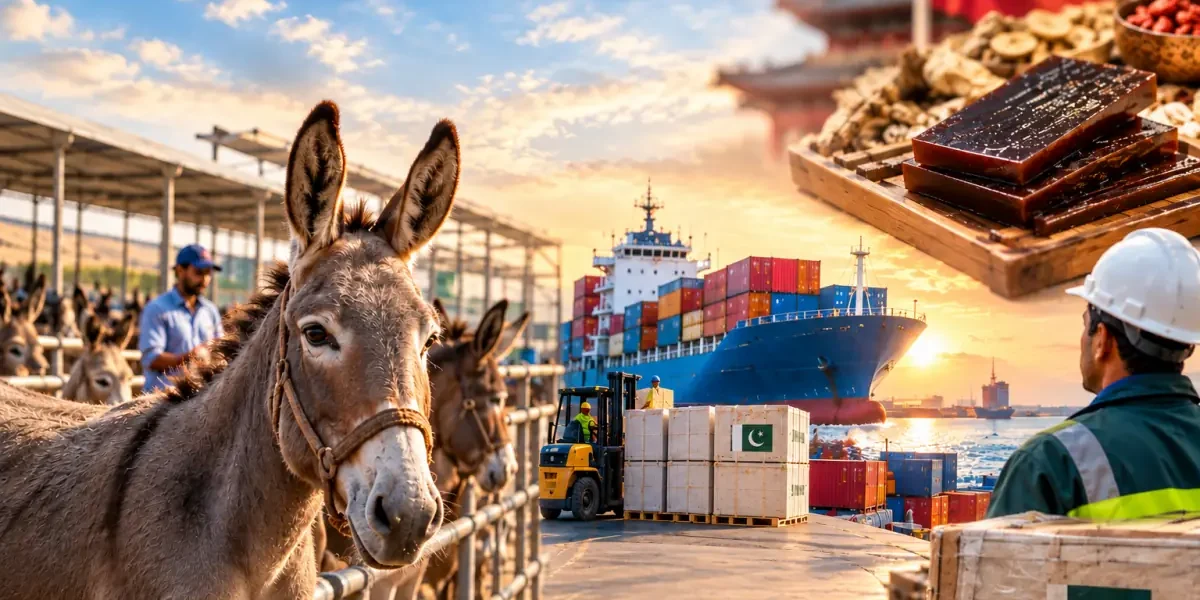
Pakistan is poised to become a significant supplier of donkeys to China, as the demand for donkey hides in traditional Chinese medicine grows. The donkey hides are used to produce ejiao, a collagen-rich gelatin that is widely used in traditional Chinese medicine and has a market value of approximately $7.8 billion.
The demand for donkey hides in China has surged due to a decline in domestic supplies, prompting the country to seek alternative sources. Pakistan, with its estimated donkey population exceeding six million, has been preparing to meet this demand through a series of strategic steps.
In October 2024, Pakistan and China signed a protocol during Chinese Prime Minister Li Qiang’s visit, outlining quarantine requirements for the export of donkey meat and hides. This agreement laid the groundwork for the export process, ensuring that the donkeys meet the stringent health and safety standards required by China.
In April 2025, the government announced that commercial export of donkey meat to China would boost Pakistan’s trade. Plans were made to establish commercial donkey breeding and processing facilities in Gwadar, a key port city under the China-Pakistan Economic Corridor (CPEC).
Chinese enterprises were allowed to set up farms, slaughterhouses, and export facilities in Gwadar’s Export Processing Zone, promoting foreign investment and economic cooperation. By July 2026, a Chinese entrepreneur named Andy successfully established a slaughterhouse in Gwadar and commenced exports to China.
Andy Liao, CEO of Hangeng Group, which operates a donkey slaughterhouse and processing facilities near Gwadar in Balochistan, plans to increase its daily slaughter capacity to 800 donkeys within months. He stated, 'The business could generate about $5 million a month in foreign-exchange earnings within six months, rising to $7 million within two years.'
The company has invested around $50 million in Pakistan over the past six years and currently employs nine Chinese managers and around 500 local workers involved in slaughtering, processing, packaging, and transportation. Hangeng Group plans to expand into donkey breeding and laboratory facilities, while eventually diversifying into seafood exports.
The export of donkey meat and hides to China is part of a broader strategy to strengthen economic ties between Pakistan and China. The process involves not only the export of animals but also the establishment of a comprehensive digital traceability system to ensure transparency, food safety, and compliance. This system tracks each animal from the farmer to the Chinese customer, providing end-to-end visibility and accountability.
The business could generate about $5 million a month in foreign-exchange earnings within six months, rising to $7 million within two years.
Andy Liao, Chief Executive Officer, Hangeng Group