
Key Takeaways
- Scientists have modeled a long-lasting cloud near Mars' Arsia Mons volcano.
- The cloud, stretching over 1,000 miles, appears and disappears seasonally.
- Researchers suggest the cloud is driven by previously unseen physical processes.
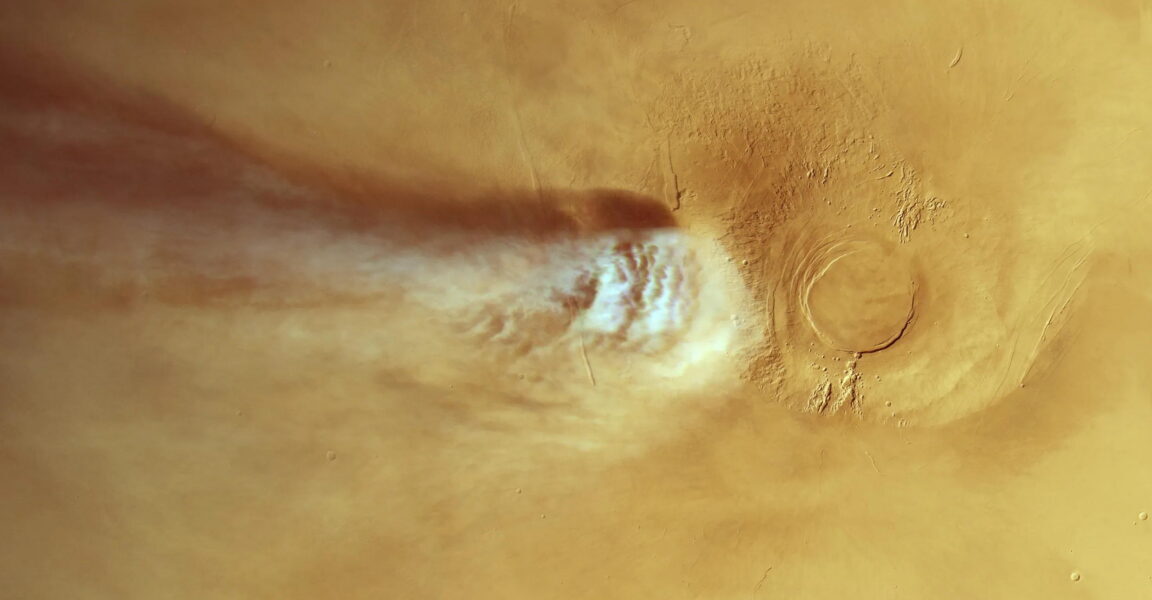
Every Martian spring and summer, a peculiar cloud emerges near the Arsia Mons volcano, stretching over 1,000 miles before dissipating. This phenomenon, known as the Arsia Mons Elongated Cloud (AMEC), has puzzled scientists since its first recorded appearance in 2018.
The cloud's formation and disappearance are part of a seasonal cycle that repeats for several months. Its length is comparable to the distance from New York to Kansas City, making it one of the longest atmospheric features observed on Mars.
Until recently, no plausible explanation existed for the cloud's existence. However, a team of researchers from Paris’ Sorbonne Université has successfully modeled the cloud's formation for the first time, revealing a physical process that has never been directly observed in any planet's atmosphere.
Jorge Hernández-Bernal, the lead author of the study, explained, 'We found that we needed to include some exotic physics… physics that, while included in textbooks, is treated as theoretical and usually thought not to happen in nature. It certainly hasn’t been seen in action before.'
The researchers' simulations, which incorporated this exotic physics, accurately predicted the AMEC's formation. 'Once we included this physics in our simulations, the AMEC emerged just as we hoped,' Hernández-Bernal stated.
This discovery not only sheds light on a unique atmospheric phenomenon but also opens up new avenues for understanding the physical processes that govern Mars' atmosphere. The findings could have implications for future Mars missions and our broader understanding of planetary atmospheres.
The AMEC's behavior challenges existing models of atmospheric dynamics and suggests that Mars may host physical processes that are not yet fully understood. This could lead to a reevaluation of how we interpret and model atmospheric phenomena on other planets.
Further research is needed to confirm the findings and explore the implications of this exotic physics. However, the AMEC's discovery marks a significant step forward in our understanding of Mars' atmospheric mysteries.
We found that we needed to include some exotic physics… physics that, while included in textbooks, is treated as theoretical and usually thought not to happen in nature. It certainly hasn’t been seen in action before.
Jorge Hernández-Bernal, Planetary scientist at Paris’ Sorbonne Université and lead author of the study