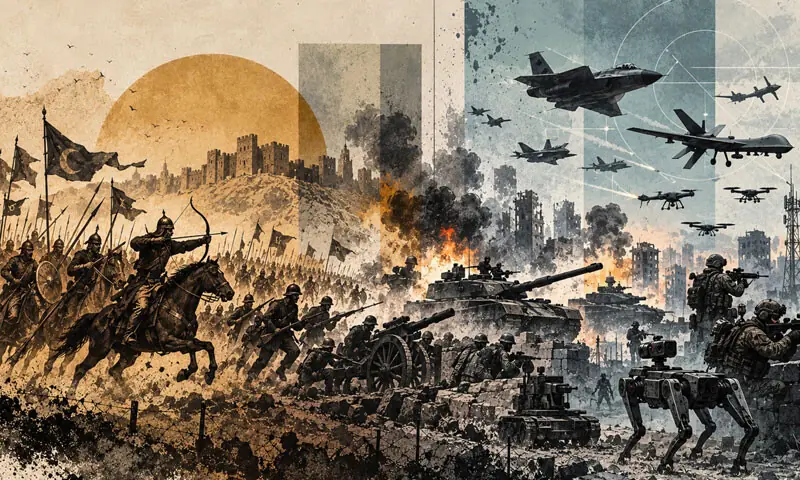
Key Takeaways
- Technological advancements have made wars more interconnected and harder to contain.
- Conflicts in Eastern Europe, the Middle East, and West Asia are becoming longer and more complex.
- Theories of war struggle to keep up with the new dynamics of modern conflicts.
Modern warfare is evolving into a complex and interconnected global challenge, as seen in ongoing conflicts in Eastern Europe, the Middle East, and West Asia. These wars are not only causing direct destruction but also creating far-reaching second- and third-order effects that extend beyond the battlefields.
The pace of technological innovation, exemplified by the Ukraine frontline, has significantly accelerated, making it increasingly difficult to sequester digital technology from adversaries. This interconnectedness means that the effects of war can spread globally, impacting economies, politics, and daily life far from the conflict zones.

For instance, attacks on Russia’s oil refineries by Ukraine have not only affected the energy markets but also had ripple effects on US domestic politics and prices. The war has impacted everything from fuel prices to bond markets and mortgage payments, highlighting the far-reaching consequences of modern conflicts.
The traditional concept of a decisive victory is becoming obsolete. Wars are increasingly indecisive, with tactical successes failing to achieve political objectives. This is evident in conflicts such as Iran against the US and Zionists, Ansar Allah against Saudi Arabia, Ukraine against Russia, and the Taliban against Pakistan. These ongoing conflicts have no clear finish line, making them harder to resolve.
The complexity of these conflicts is further compounded by the 'arena problem,' where the battlefield is no longer confined to a single location. Commanders can no longer rely on traditional methods of command and control, such as dispatching runners with new instructions. Instead, they must navigate a complex web of digital and physical interconnectedness, making the outcomes of these wars more unpredictable.
Theories that once helped us understand war are struggling to keep up with the new dynamics. Attrition, technological disruption, economic warfare, and geopolitical rivalry are producing conflicts with no obvious finish line. The international system is increasingly incapable of containing these conflicts, leading to a global security landscape that is more volatile and unpredictable.
The ongoing wars in Eastern Europe, the Middle East, and West Asia are creating a new age of war, characterized by complexity, interconnectedness, and a lack of clear resolution. As these conflicts continue to evolve, the need for new theories and strategies to understand and manage them becomes more urgent.
In conclusion, the modern age of war is marked by technological advancements, complex global impacts, and a lack of clear resolution. Understanding these new dynamics is crucial for policymakers, military strategists, and the general public to navigate the challenges of the 21st century.