Key Takeaways
- Maulana Fazlur Rehman clarifies JUI-F's criticism is directed at policies, not institutions.
- Federal ministers accuse Fazl of seeking 'share' in KP governance following emergency rule.
- Fazl calls for an in-camera session of Parliament to review security policies.
Maulana Fazlur Rehman, the chief of Jamiat Ulema-i-Islam-Fazl (JUI-F), has clarified that his party's recent remarks regarding the country's security situation were directed at policies, not institutions. This clarification came in response to allegations made by federal ministers that he was seeking a 'share' in the governance of Khyber Pakhtunkhwa (KP).
Interior Minister Mohsin Naqvi, without naming anyone, claimed that a 'head of a party' was 'extremely upset' about not being appointed the governor of KP. State Minister for Interior Tallal Chaudhry also rebuked Fazl for reportedly seeking his 'share' in KP's governance following the imposition of governor's rule and an emergency in the province.
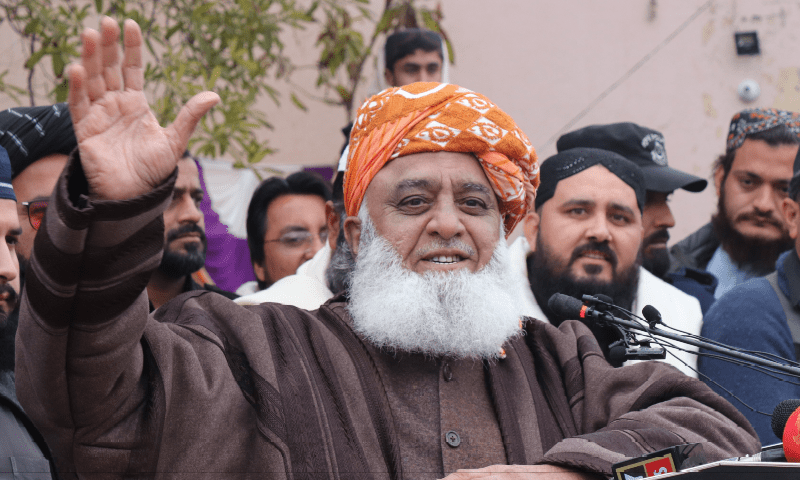
Addressing a press conference in Lahore, Fazl stressed that his party's criticism was aimed at policies, not institutions, and was intended to bring about corrective action rather than undermine the sacrifices made in the fight against terrorism. He called for an in-camera session of Parliament to review the country's security situation and formulate a consensus-based policy to combat terrorism.
Fazl highlighted the need for Parliament to be the most appropriate forum to discuss the issue and make decisions, rather than being merely told to follow them. He questioned why decisions were taken in Rawalpindi and implemented obediently by Parliament. He alleged that the government was powerless, with decisions being taken elsewhere and Parliament simply following them.
The JUI-F chief maintained that Parliament should review the security situation and take the public into confidence. He argued that if the public was expected to support the fight against terrorism, the government should explain its decisions rather than impose 'unilateral measures'.
Fazl reiterated his objection to the imposition of emergency rule in KP or any other part of the country. He recalled his family's opposition to emergency rule in Balochistan during the 1970s, when his father had resigned when the government of Zulfikar Ali Bhutto imposed it in the province. He described the recurrence of such measures as unfortunate, pointing out that the PP had repeatedly been associated with their imposition.
Questioning the rationale behind the emergency, governor's rule, and the deployment of troops in KP, Fazl asked why the province should face such treatment when Balochistan was also grappling with the same level of terrorist violence, if not more. He urged the government to develop a shared national narrative and a consensus-based counterterrorism strategy instead of questioning his party's position.
Fazl's comments come amid ongoing tensions between the JUI-F and the federal government over governance and security policies in KP. The JUI-F has maintained that its criticism is constructive and aimed at bringing about positive change, rather than undermining the fight against terrorism.