Key Takeaways
- Brics leaders including China, Russia, and India met in New Delhi to discuss inclusive global growth.
- The group aims to bolster its global influence and address conflict, trade turbulence, and energy security.
- Indian Prime Minister Narendra Modi called for cooperation within the bloc, representing 50% of the world’s population.
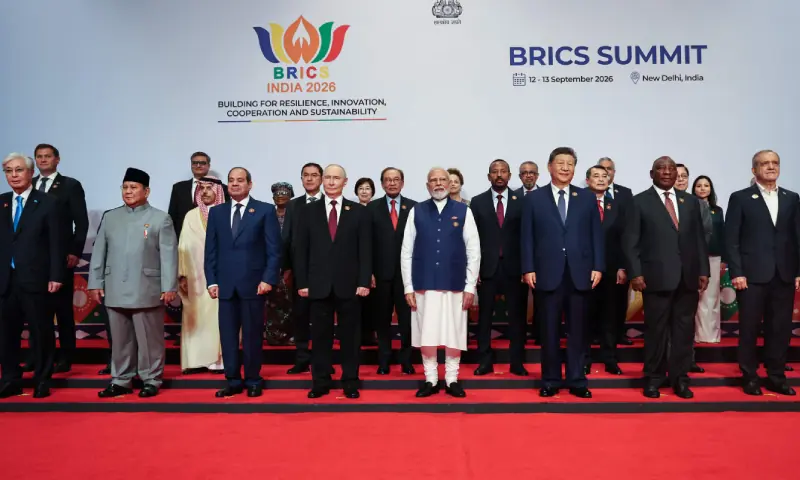
Brics leaders, including China, Russia, and India, continued their discussions on economic cooperation and inclusive global growth during a two-day summit in New Delhi on Sunday.
The summit, which began on Saturday, focused on addressing issues such as conflict, trade turbulence, and energy security, with a particular emphasis on the ongoing Middle East conflict.
Indian Prime Minister Narendra Modi highlighted the bloc’s potential, stating that Brics represents 50% of the world’s population, 40% of global GDP, and more than 25% of global trade.
Modi emphasized the importance of cooperation within the Brics framework, noting that the group’s strength lies in its diversity and collaborative efforts.
The leaders issued a joint statement expressing deep concern over the continued escalation of tensions in the Middle East, calling for maximum restraint.
The summit also marked Chinese President Xi Jinping’s first visit to India since 2019, signaling a cautious thaw in relations between the nuclear-armed rivals.
Despite the underlying territorial dispute and strategic rivalry, both sides expressed a commitment to a fair, reasonable, and mutually acceptable resolution of the boundary question.
India has navigated the energy crisis caused by the US-Israeli war on Iran by turning to Russia, despite Moscow’s war in Ukraine and pressure from Western capitals.
The Brics group was created in 2009 as a forum for major emerging economies seeking greater influence in institutions dominated by Western powers, aiming to address global challenges through collective action.
The power of Brics lies in our diversity and cooperation.
Narendra Modi, Indian Prime Minister
Although our two countries are different in many respects, they are fully capable of complementing each other’s strengths, supporting one another, achieving mutual success and advancing together.
Xi Jinping, Chinese President