LIVE Watch Now Punjabi News Channel from Pakistan
Breaking
Pakistan women’s cricket team departs for Asian Games in JapanPSX Plummets as KSE-100 Index Loses 2,541 PointsHaripur administration directs action on industrial water pollutionPC Hotel Owners Confirm Restructuring Talks to Resolve Legal DisputeOil prices rise as attacks on Saudi Arabia pipeline stoke supply fearsGovernment to Provide Rs25bn Monthly for Fuel Relief SchemeSri Lankan shares decline amid healthcare, energy sector lossesKP wheat stocks fall to 189,000 tonnesPunjab to Enhance Coordination in Enforcement OperationsGovernment Considers Reviving Austerity Measures Amid Fuel CrisisGulf fintech Tabby raises $233 million, valued at $6.5 billionIndia’s Wholesale and Retail Inflation Rise, Fueling ConcernsXiaomi Launches $9 Smart Plug for Home AutomationLahore Police to Install Hidden Recording DevicesPakistan Army Opens 33 Civilian Jobs for Retired OfficersPIA and Kam Air Sign Agreement for Simplified Afghan to Middle Eastern TravelKP Chief Minister Launches Pishtakhara Underpass ProjectUK Lawmakers Call for AI Regulation to Protect Human RightsIndia’s Solar Industries to Acquire South Africa’s Omnia for $1.36 BillionPalm oil prices rise on strong crude oil marketPakistan women’s cricket team departs for Asian Games in JapanPSX Plummets as KSE-100 Index Loses 2,541 PointsHaripur administration directs action on industrial water pollutionPC Hotel Owners Confirm Restructuring Talks to Resolve Legal DisputeOil prices rise as attacks on Saudi Arabia pipeline stoke supply fearsGovernment to Provide Rs25bn Monthly for Fuel Relief SchemeSri Lankan shares decline amid healthcare, energy sector lossesKP wheat stocks fall to 189,000 tonnesPunjab to Enhance Coordination in Enforcement OperationsGovernment Considers Reviving Austerity Measures Amid Fuel CrisisGulf fintech Tabby raises $233 million, valued at $6.5 billionIndia’s Wholesale and Retail Inflation Rise, Fueling ConcernsXiaomi Launches $9 Smart Plug for Home AutomationLahore Police to Install Hidden Recording DevicesPakistan Army Opens 33 Civilian Jobs for Retired OfficersPIA and Kam Air Sign Agreement for Simplified Afghan to Middle Eastern TravelKP Chief Minister Launches Pishtakhara Underpass ProjectUK Lawmakers Call for AI Regulation to Protect Human RightsIndia’s Solar Industries to Acquire South Africa’s Omnia for $1.36 BillionPalm oil prices rise on strong crude oil market
◕ SundialUpdated 8 hours ago
Trending
Science & Health

Glacier melt threatens Himalayan water security

Study warns Himalayan glaciers are melting faster, posing severe risks to water security and millions of livelihoods.

Add Sun News on Google News
Glacier melt threatens Himalayan water security
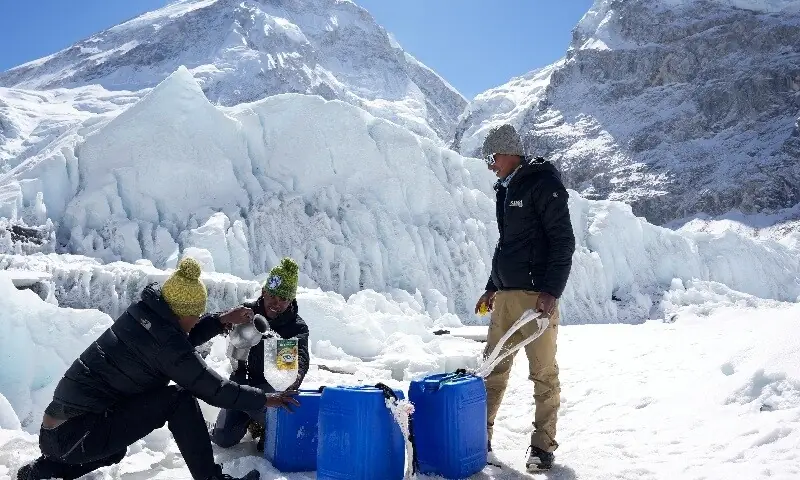
People affected by recent glacier collapses in the Himalayas.

Key Takeaways

  • Himalayan glaciers are melting faster than a decade ago, posing a threat to water security.
  • At least 1,300 people have died in recent glacier collapses in Nepal and China’s Tibet region.
  • Millions of livelihoods in the region are at risk as glacial lakes become unstable.

A study released this month has warned that the Himalayas are approaching a tipping point, with glaciers melting faster than a decade ago. The research, conducted by Systemiq and several other organizations, highlights the urgent need to address the issue before it leads to severe water shortages.

The findings come after a devastating glacier collapse in late August along the Nepal-Tibet border, which caused cascading landslides and flash floods. At least 1,300 people have been confirmed dead, and more than 5,300 are missing across Nepal and China’s Tibet region.

As glaciers retreat, they are leaving behind unstable glacial lakes, which are held back by little more than loose rock and ice. These lakes are situated above valleys where millions of people live, creating a significant risk of further disasters.

AdvertisementFollow Sun NewsWatch Live

The study found that glacier mass loss in the Hindu Kush-Himalaya region has accelerated in recent decades. Only 21 out of an estimated 40,000 glaciers are currently monitored on the ground, highlighting the scale of the challenge. In India alone, close to 200 glacial lakes have been identified as high risk, with 56 classified as 'very high risk'.

The region is nearing 'peak water', the point when river flows stop rising and start declining. This has profound implications for water security, as the Himalayas underpin more than 20 per cent of India’s GDP. The region is a key piece of the country’s national economic infrastructure, upon which hundreds of millions of people depend.

The study also noted that though the Himalayan region makes up around 18 per cent of India’s land, it accounts for roughly 35 per cent of the country’s natural disasters. This underscores the critical role the region plays in both economic and disaster management contexts.

Experts warn that without immediate action, the situation could worsen, leading to severe water shortages and increased risk of landslides and floods. The study calls for a coordinated international effort to monitor and manage the region’s glaciers to mitigate these risks.

The findings of the study are alarming, as they highlight the urgent need for action to protect the millions of livelihoods at stake in the Himalayan region. The international community must work together to address this pressing issue before it leads to irreversible damage.