Key Takeaways
- Pakistan calls for immediate establishment of global regulatory frameworks for digital assets.
- Minister Bilal Bin Saqib urges coordinated governance to ensure economic inclusion.
- Digital assets offer opportunities for financial modernisation and inclusion, according to PVARA chief.
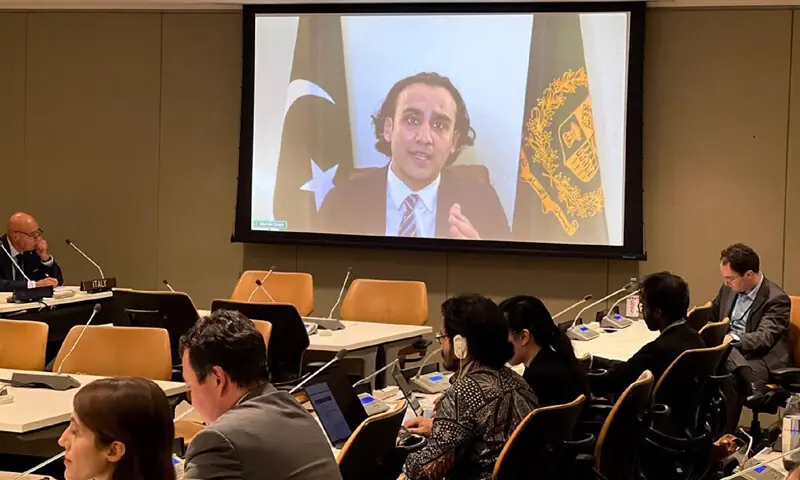
Pakistan has called for the immediate establishment of global regulatory and institutional frameworks to govern digital assets, according to a statement made by the Minister of State and Pakistan Virtual Assets Regulatory Authority (PVARA) Chairman, Bilal Bin Saqib, at a United Nations briefing.
The session, titled 'Digital Assets and Blockchain for Sustainable Development: Advancing Digital Finance through Innovation,' was held at the United Nations headquarters and brought together member states, UN entities, and private-sector stakeholders.
Saqib highlighted the importance of coordinated governance to ensure that digital assets drive economic inclusion and efficiency, stating, 'The question before this room is not whether these technologies will scale. They will. The question is: who will shape them, and in whose interest?'
He emphasized that emerging technologies such as tokenisation and distributed ledgers offer a critical opportunity to modernize global financial infrastructure. Saqib pointed to the 1.4 billion adults globally who remain outside the formal financial system, alongside billions more who participate on unequal terms through expensive remittances, slow settlement, and limited access to credit.
The minister argued that digital finance’s development potential extends well beyond payments, noting that digital identity and verifiable financial histories could help small businesses, farmers, and women entrepreneurs demonstrate economic activity without relying exclusively on traditional collateral or documentation.
Tokenisation could create new ways to mobilize capital by fractionalizing assets ranging from infrastructure bonds to renewable energy projects, while distributed ledgers could strengthen transparency across public expenditure and supply chains.
However, Saqib cautioned against treating technology as an automatic solution, highlighting risks such as retail volatility, illicit finance, and the concentration of power. He warned that frameworks introduced too late can fail consumers and markets, while regulation driven primarily by fear can push technological activity into less transparent environments.
The emerging lesson from jurisdictions around the world, he said, is that regulation should be treated as market-building rather than market-blocking. 'No nation rises alone, and no nation should be left to rise alone,' he urged member states to use the briefing as a platform for collaboration.
Saqib stated that the choice before every member state is not to regulate or not to regulate, but to govern the future, or be governed by it. He emphasized the need for regulation to evolve alongside innovation to protect consumers and markets.
The question before this room is not whether these technologies will scale. They will. The question is: who will shape them, and in whose interest?
Bilal Bin Saqib, Minister of State and PVARA Chairman