Key Takeaways
- Indian Prime Minister Modi and Chinese President Xi Jinping committed to resolving their countries' contested border.
- The meeting, part of Xi's first visit to India since 2019, focused on mutual respect and cooperation.
- Trade was highlighted as a key area for collaboration, though India faces a significant trade deficit with China.
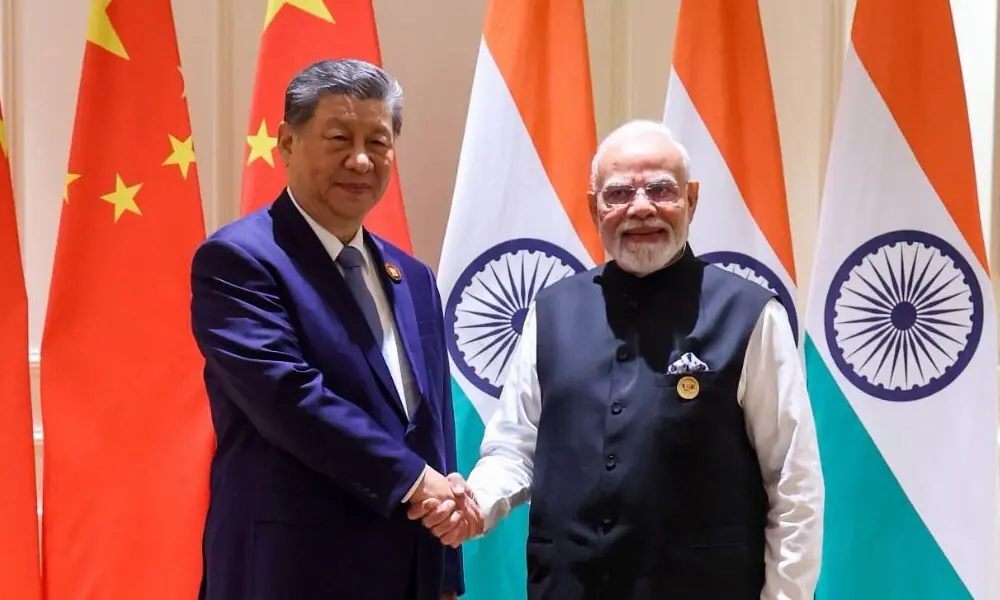
Indian Prime Minister Narendra Modi and Chinese President Xi Jinping agreed to work towards resolving their countries' contested border, according to a statement from New Delhi’s foreign ministry.
This agreement came during Xi’s visit to New Delhi for the 11-nation BRICS summit, marking his first visit to India since 2019 and the biggest step in a cautious thaw between the nuclear-armed rivals.
During their meeting, Xi emphasized the potential for mutual success and cooperation, stating, 'Although our two countries are different in many respects, they are fully capable of complementing each other’s strengths, supporting one another, achieving mutual success and advancing together.'
Modi underscored the importance of observing existing agreements and understandings on border-related issues, as stated in the Indian foreign ministry’s statement.
The underlying territorial dispute remains unresolved, with both sides maintaining heavy military deployments along their roughly 3,500-kilometre high-altitude border in Tibet.
Despite the ongoing tensions, the leaders agreed to address each other’s concerns, including structural trade imbalances and supply chain issues, aiming for meaningful and predictable market access.
Trade was another focus of the meeting, with China now India’s largest trading partner. Bilateral goods trade reached $151 billion in the 2025-26 financial year, according to Indian government data.
However, the relationship is heavily tilted towards Beijing, with India importing $131 billion of goods from China and exporting only $19 billion, resulting in a record $112 billion trade deficit.
Both leaders highlighted the need for high-quality major financial cooperation and advocated for an equal and sustainable global order, fostering an open and inclusive economic globalization.
Although our two countries are different in many respects, they are fully capable of complementing each other’s strengths, supporting one another, achieving mutual success and advancing together.
Xi Jinping, Chinese President
Both sides should… work hand-in-hand to promote high-quality major financial cooperation, advocate an equal and sustainable global order, and foster an economic globalisation that is open and inclusive.
Xi Jinping, Chinese President