Key Takeaways
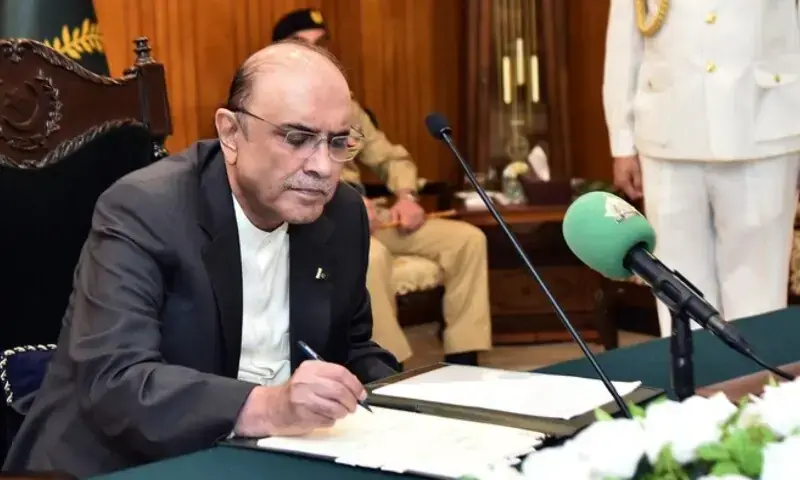
- The federal government is considering issuing notifications for high court judges despite President Asif Ali Zardari not having formally approved the recommendations.
- Sources warn that bypassing the procedure could lead to complications and political tensions.
- The Islamabad High Court has reserved its verdict on a plea challenging the delay in notifying appointments.
The federal government is considering issuing notifications for high court judges despite President Asif Ali Zardari not having formally approved the recommendations made by the Judicial Commission of Pakistan (JCP), sources told Dawn.
During its meetings held on July 20 and 21, the JCP recommended the appointment of 19 additional judges to the high courts, confirmed the services of four additional judges of the Peshawar High Court, and extended the tenure of an additional judge of the Sindh High Court by six months.
However, the appointments have yet to be notified by the Ministry of Law and Justice as the president has not formally approved the summary. The government is examining the possibility of invoking Article 48(1) of the Constitution to issue the notification.
According to informed sources, the delay in notifying the appointments has already created practical complications. Four additional judges of the Peshawar High Court ceased to hold office after their expiry of tenure on Aug 4 due to the absence of a formal notification.
Similarly, an additional judge of the Sindh High Court, whose term had been extended by the JCP for another six months, also relinquished office after his term expired on July 29.
When contacted, Minister of State for Law and Justice Barrister Aqeel Malik said the government would resolve the matter within the constitutional framework and in accordance with the procedure prescribed by the Constitution and the principles laid down by the superior courts.
Sources in the Presidency cautioned against bypassing the prescribed procedure, warning that any such move could trigger political and legal complications. They said Articles 48(1) and 48(2), which define the respective constitutional roles of the president and the prime minister, as well as Article 175A(8), which deals with the appointment of judges, left room for differing interpretations.
According to Presidency sources, any ambiguity should be resolved through mutual consultation between the president and the prime minister rather than through unilateral action. On the other hand, government sources maintained that judicial appointments were governed by constitutional provisions and that any deadlock must be resolved strictly in accordance with the Constitution.
The Islamabad High Court has reserved its verdict on a plea challenging President Zardari’s delay in approving a summary for the appointment and confirmation of judges to various high courts. The writ petition, filed by advocate Luqman Zafar Chaudhary through his counsel Zahid Asif Chaudhry, urged the court to take action.