Key Takeaways
- Phutti arrivals at ginning factories increased by 32.33% year-on-year.
- Sindh recorded a record 66.82% increase, while Punjab saw a slight decline.
- Textile mills purchased 704,000 bales, with exports buying 3,400 bales.
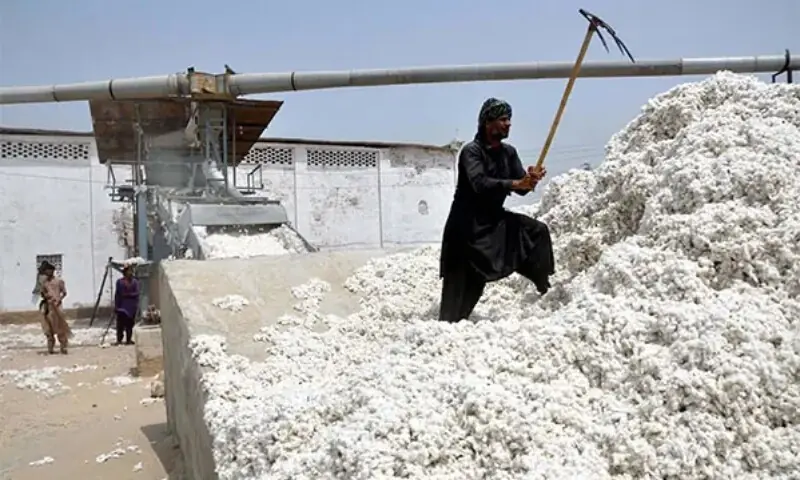
Phutti (seed-cotton) arrivals at ginning factories in Pakistan surged by more than 32% year-on-year as of July 31, according to the Pakistan Cotton Ginners Association (PCGA).
The increase was driven primarily by a record 66.82% rise in Sindh, despite recent monsoon rains, while Punjab experienced a slight decline of 1.1%. Balochistan also saw a significant 52.67% rise.

However, there is a notable discrepancy between the PCGA figures and those from the Punjab government’s Crop Reporting Service (CRS), with the latter claiming production of about 435,000 bales by July 30, roughly 32% higher than the PCGA estimate.
Cotton Ginners Forum Chairman Ihsanul Haq highlighted that Sindh's record surge offsets Punjab’s decline. He also pointed out an alarming collapse in cotton cultivation across Bahawalpur Division, where only around 17,000 bales were produced despite once being a leading cotton-growing belt.
Haq attributed the decline to the rapid expansion of sugarcane cultivation driven by sugar mills, transforming traditional cotton zones into sugarcane belts. He warned that shrinking cotton acreage is forcing Pakistan to rely increasingly on imports of both cotton and edible oil.
Pakistan imported 3.482 million tonnes of edible oil worth $3.785 billion in the 2025-26 fiscal year, compared with 3.214 million tonnes valued at $3.40 billion a year earlier.
The PCGA report indicated that textile mills purchased 704,000 bales of phutti, while exporters bought only 3,400 bales, leaving 78,044 bales unsold at ginning factories.
There were 231 operational ginning factories across the country, including 108 in Punjab and 123 in Sindh. Some units had either become partially operational or suspended operations due to financial and commercial constraints.
Sajid Mahmood, head of the Transfer of Technology Department at the Central Cotton Research Institute (CCRI), Multan, noted that early-season figures suggested a stronger start than last year, particularly in Sindh where timely sowing, harvesting, and improved crop management had supported higher arrivals.
While the PCGA data showed phutti arrivals in Punjab at around 298,000 bales, the CRS claimed production of about 435,000 bales by July 30, roughly 32pc higher than the PCGA estimate.
Cotton Ginners Forum Chairman Ihsanul Haq